From reactive queries to proactive context aware AI insights for cloud platform
As a founding designer for the ML/AI domain, I led design for Slingshot, a platform that provides visibility, governance, and optimization across Snowflake and Databricks environments.
I designed a context-aware AI system that reasons across queries, lineage, and workloads to surface safe, actionable optimization opportunities. The system combines AI insights, explainability, and context-aware conversations to help data analysts diagnose root causes, identify duplicate pipelines, understand cost drivers, and make informed optimization decisions.
Targeted for 25–40% reduction in manual RCA and cost optimization and query tuning effort. Fewer context switches (from ~4–5 tools to 1 integrated experience)
Intelligence and Agent Behavior Design:
My Role
Founding AI / ML UX Designer (Contract)
Timeframe: past 1 year - present
Core Team
Product Management
Engineering
Machine Learning
Design
Domain SMEs (Data & Platform Experts)
Leadership
Cross-Functional
Platform and infrastructure teams (Snowflake/ Databricks)
Go-to-market and stakeholder leadership
AI Research Team
External customers (early feedback & validation)
My Responsibilities
- Responsible for defining Slingshot’s AI vision, agentic UX strategy, and system-level design direction, from early exploration through MVP delivery.
- Owned AI product vision and long-term design strategy in collaboration with product, ML, and leadership
- Led design-driven discovery to identify viable AI use cases and maturity progression (automation to copilot to agentic)
- Designed system behavior, agent reasoning flows, and human-in-the-loop interactions — not just UI screens
- Executed hands-on design across prototypes, system flows, and MVP-ready artifacts
- Established the foundational AI UX patterns and design principles for Slingshot
- Partnered closely with engineering to translate agentic concepts into buildable MVPs
- Influenced the long-term AI roadmap for the Slingshot platform
Scope
- AI product strategy & system design
- Agentic UX and human–AI collaboration
- Model behavior and reasoning design
- Design-led AI discovery and capability exploration
- Trust, explainability, and decision-support UX
- MVP design and technical handoff
- Long-term AI maturity and evolution planning
This case study contains my own views and does not reflect the views of the organisation. All examples are anonymized and simplified for confidentiality. Metrics and outcomes reflect design intent rather than production-measured results.
Project Overview
Slingshot is Capital One Software’s enterprise platform for managing cloud data cost, performance, and governance across Snowflake and Databricks.
When I joined, there was no PRD, no technical specification, and no defined AI direction. The organization knew AI was important, but there was no shared understanding of what kind of AI would actually deliver value in complex data systems.
This work was entirely design-led.
I used prototypes—not documents—to educate the organization, define AI maturity, and shape the system that is now being tested as Slingshot’s flagship context-aware agentic AI direction for 2026.
The Problem
Enterprise data teams face:
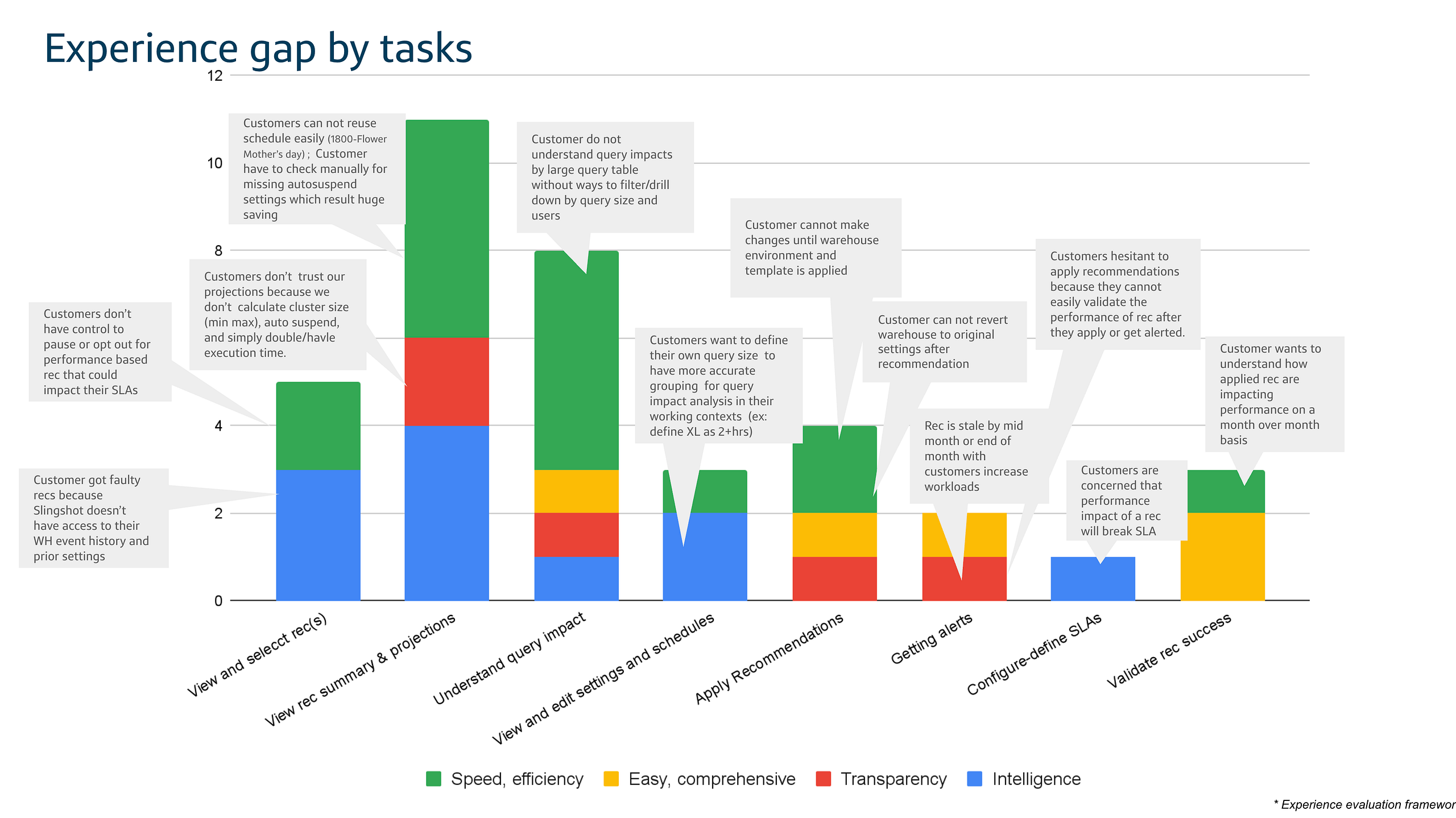
- Rising cloud data costs
- Slow and opaque query performance
- Duplicate pipelines and redundant workloads
- Manual, fragmented root-cause analysis across tools
- Competitors in AI space
Before AI, users relied on:
- Static dashboards
- Deterministic alerts
- Manual investigation across lineage, logs, and cost reports
The result: high cognitive load, slow diagnosis, and low confidence in decisions.
Solution - Context aware agentic AI
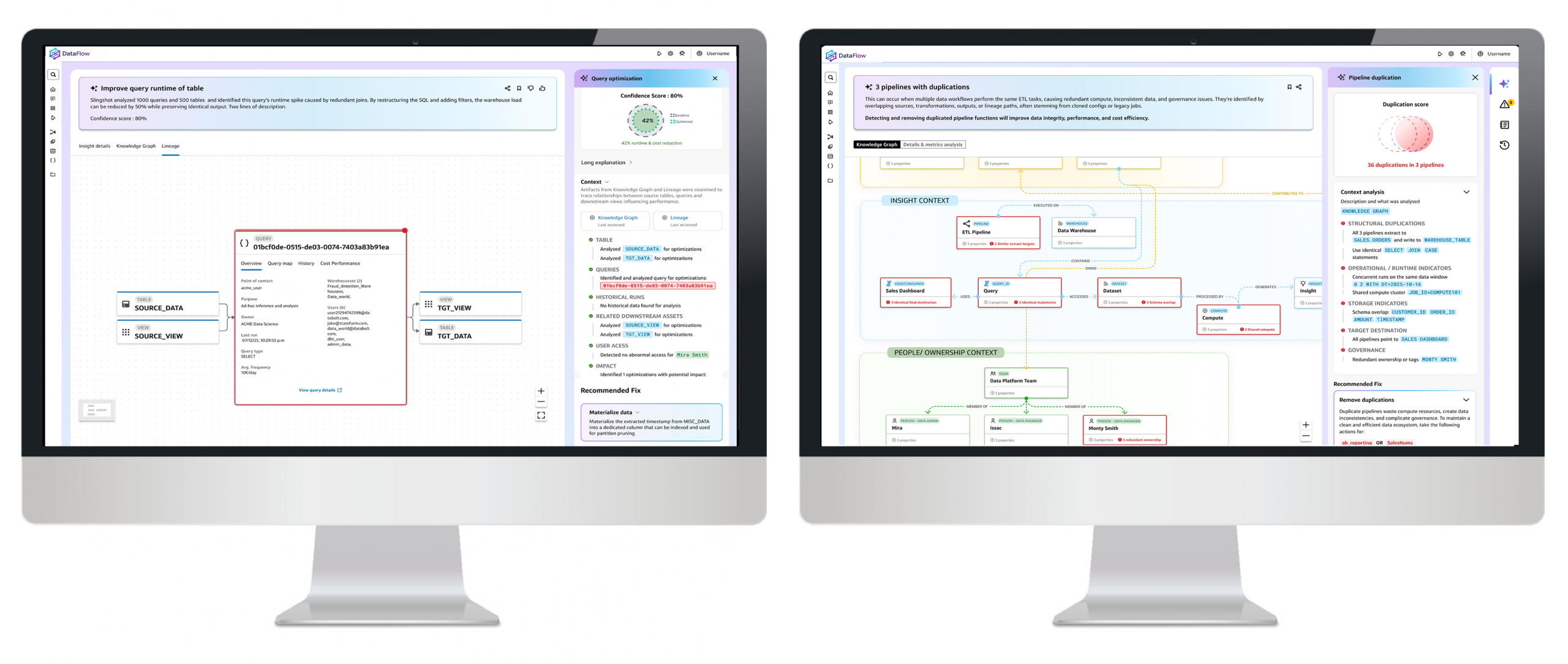
A solution that provides deep insights and actionable optimizations to help customers reduce waste, improve performance, and detect and resolve data infrastructure issues faster—by expanding beyond compute optimization to understand and optimize performance across the entire Snowflake and Databricks ecosystem.
Context aware AI
- Understands the situation by using surrounding information (history, metadata, relationships, system state)
- Produces better-informed answers or recommendations
- Still reacts to prompts or triggers (event, query, user action)
Example: “This query is expensive because it scans three large tables and runs every hour.”
(Explainability, Trust and Evidence)
Agentic AI
- Proactively identifies problems and opportunities
- Plans multi-step actions over time
- Collaborates with humans through approval, escalation, and learning loops
Example: “I detected rising query cost, analyzed lineage and usage, proposed optimizations, and tracked results after changes.”
(Reasoning, Human-in-the-loop, Memory, and Safety)
Product Design Process
(Not a traditional UX design process)
This is a modern design process for AI products that goes beyond traditional UX, focusing on system behavior, trust, and learning over time, and working closely with product teams from early direction through MVP delivery and iteration.
Vision
Define AI Strategy
Frame the product & system problem space
New Domain added for ML/AI
Ideation
AI Capability Exploration
Educate the team through prototypes - interactive and videos
Use prototypes to validate behavior, not just UI
Explored RAG, Copilot, and Agentic patterns
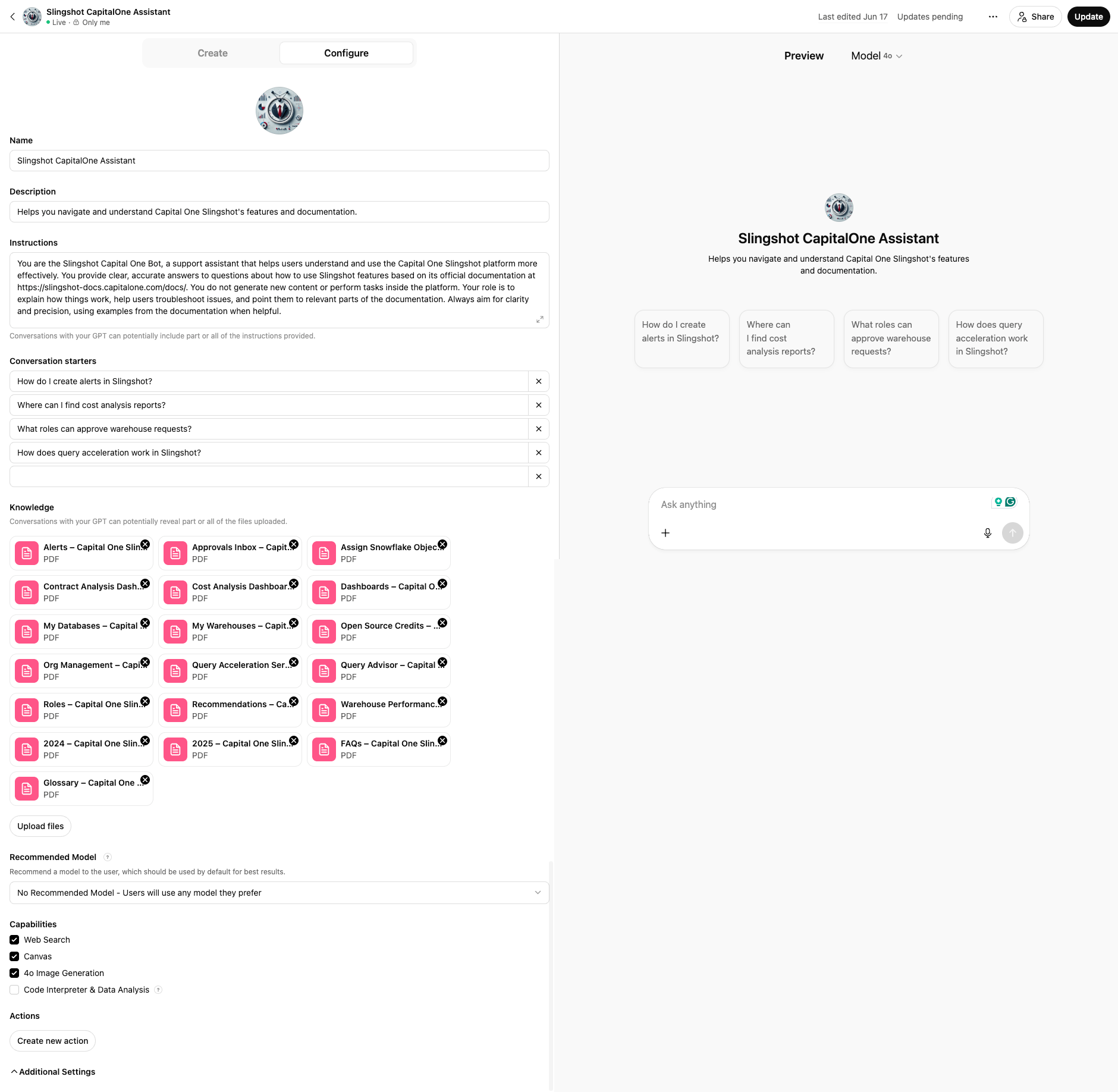
Built GPTs, demos, and lightweight prototypes
Narrowed down high value usecases
Research
Product, Market, User
Conduct deep competitive analysis focused on capabilities, not features
Identify gaps between market claims and real system behavior
Compare competitor workflows with real user workflows
Synthesize competitive insight into actionable user and system understanding
Ideation -AI Capability Explorations
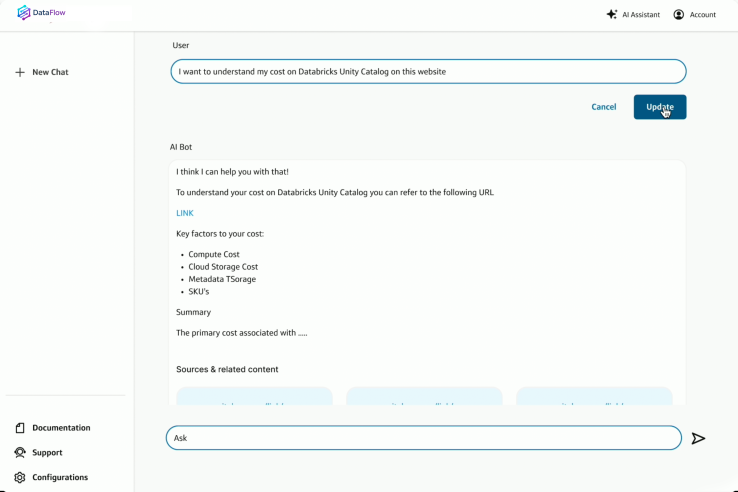
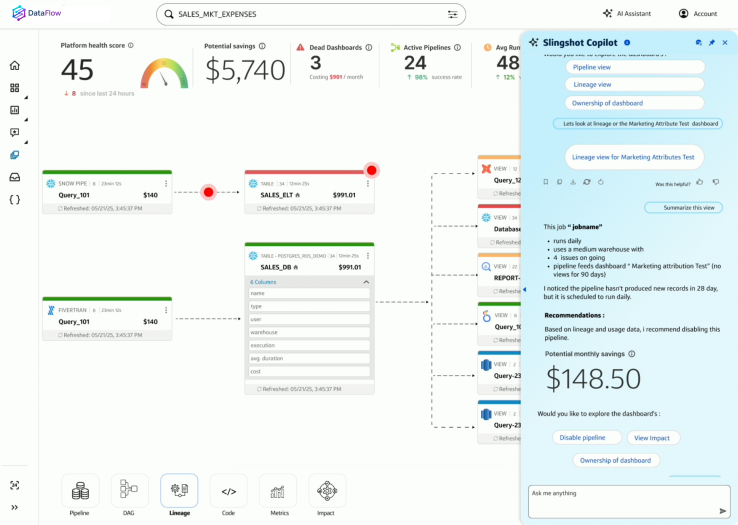
I led a 6-month design-led exploration using working prototypes rather than documents to evaluate different AI interaction models. This allowed stakeholders to experience AI behavior firsthand and align on limitations early.
Explored Patterns & Feedback
Figma interactive prototypes & video demo
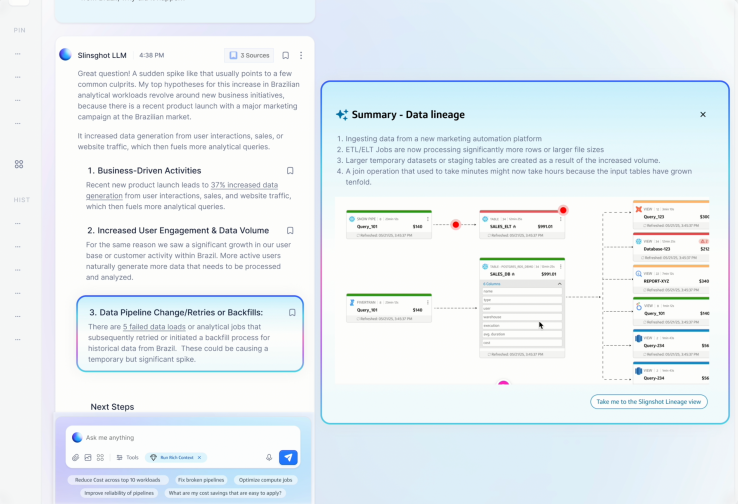
AI Rapid prototypes
For AI-native products, static wireframes are insufficient to validate system behavior. To explore reasoning quality, trust signals, and interaction patterns before committing to implementation, I used AI-assisted rapid prototyping as a core design method.
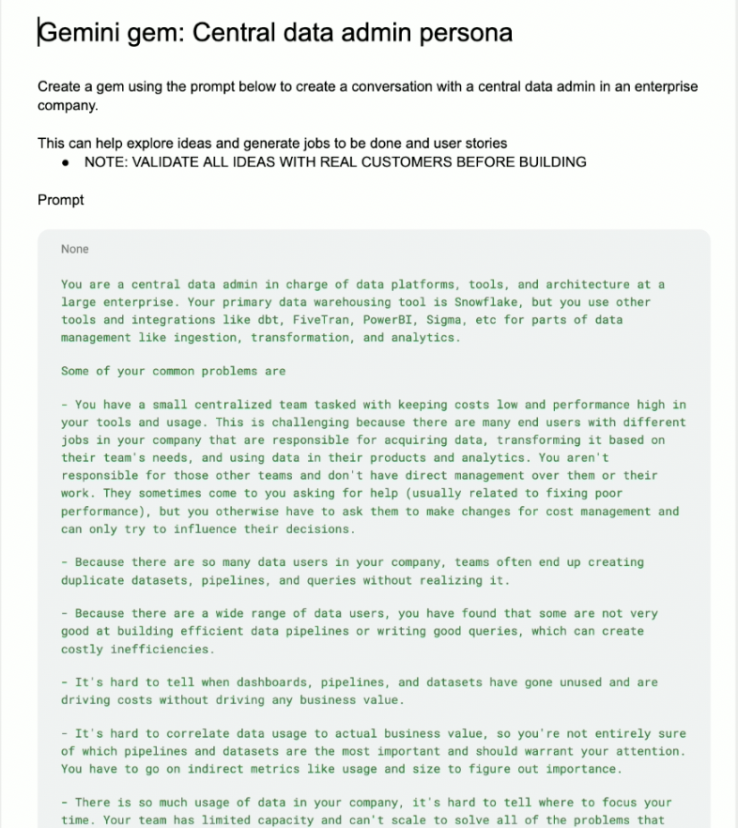
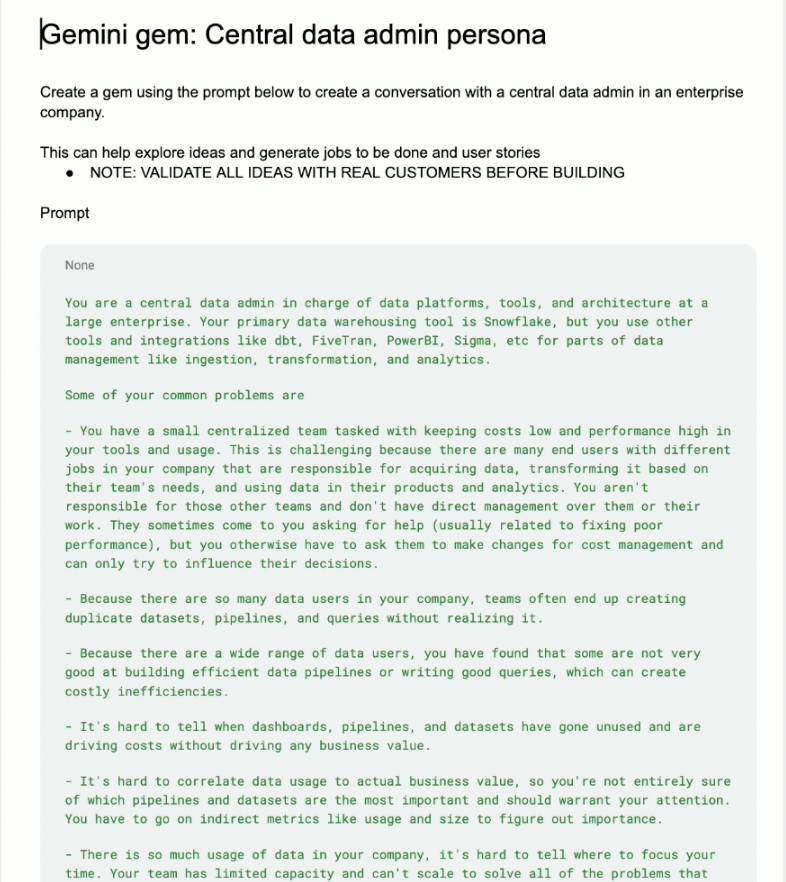
Gemini GEM Personas
ChatGPT
Created persona-based prompting scenarios (analyst, platform admin, executive) to test role-specific AI expectations.
What it demonstrated ?Generic AI responses failed to adapt to role, risk tolerance, and decision context.
Insight: AI behavior must be persona-aware at the reasoning level—not just UI copy or tone.
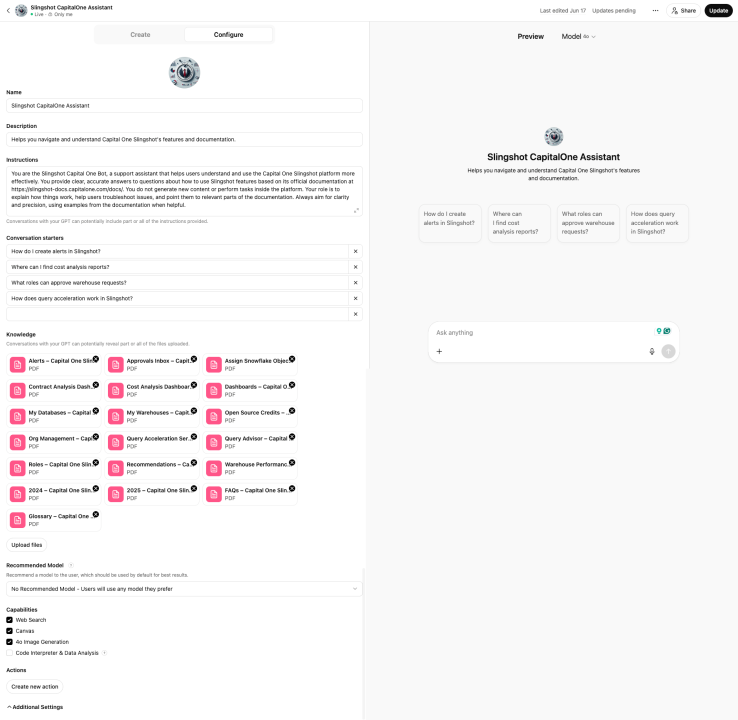
Vibe Coding/Designing Prototypes
ChatGPT
Used AI AI to prototype, validate ideas, speed up exploration, analyze data, evidence-first explanations, and early agent behaviors.
What it demonstrated ? Systems grounded in evidence and context outperformed narrative or summary-based AI patterns.
Insight: AI value emerges from context orchestration (lineage, cost, usage), not isolated model output.
Key Learnings
- Chat-first AI was insufficient for complex, high-risk data decisions.
- Deterministic automation scaled poorly in ambiguous, multi-system environments.
- Prototypes (not docs) were the fastest way to align leadership on AI capability limits.
- AI value emerged only when context (lineage, cost, usage) was combined—never in isolation.
- There were more focused usecases and clarity for the team to move forward.
Outcome
- One of these prototypes was a success at a Cloud Summit, and it was most welcomed by the tech and the product teams.
- Eliminate chat-only and automation-only paths early
- Establish a shared mental model for AI capability and limitations
- Create alignment around the need for context-aware, agentic system design
- Tech POC started - exploring models and agents
- This set the foundation for designing intelligence, not interfaces.
Research - Product, Market and User
As part of early discovery, I led product, user, and system research to move Slingshot from broad AI exploration toward focused, high-impact AI use cases tied to real business outcomes
This phase combined market intelligence, competitive analysis, and system-level user understanding to answer a critical question: where can AI meaningfully reduce effort and improve decision quality in complex data workflows?
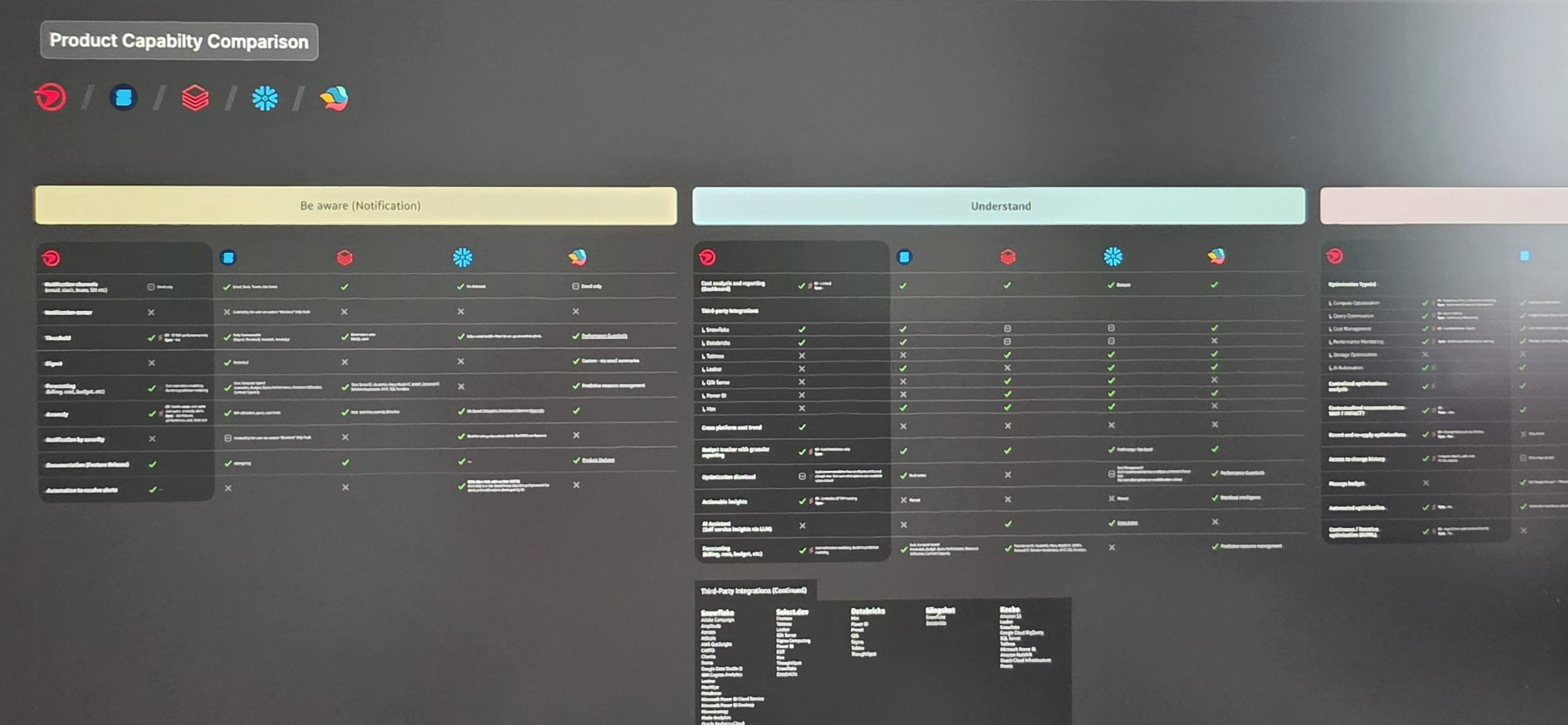
Competitor Analysis
Rather than treating competitor analysis as feature comparison, I approached it as market intelligence. From early prototypes, prior internal research, and feedback from engineering, it became clear that the AI landscape was evolving rapidly. I conducted ongoing competitive analysis—first broadly across AI tools, then deeply within adjacent domains such as DBT Cloud, Matillion, and Unravel.
Throughout the project, I did competitor analysis as the AI space was changing at lightning speed
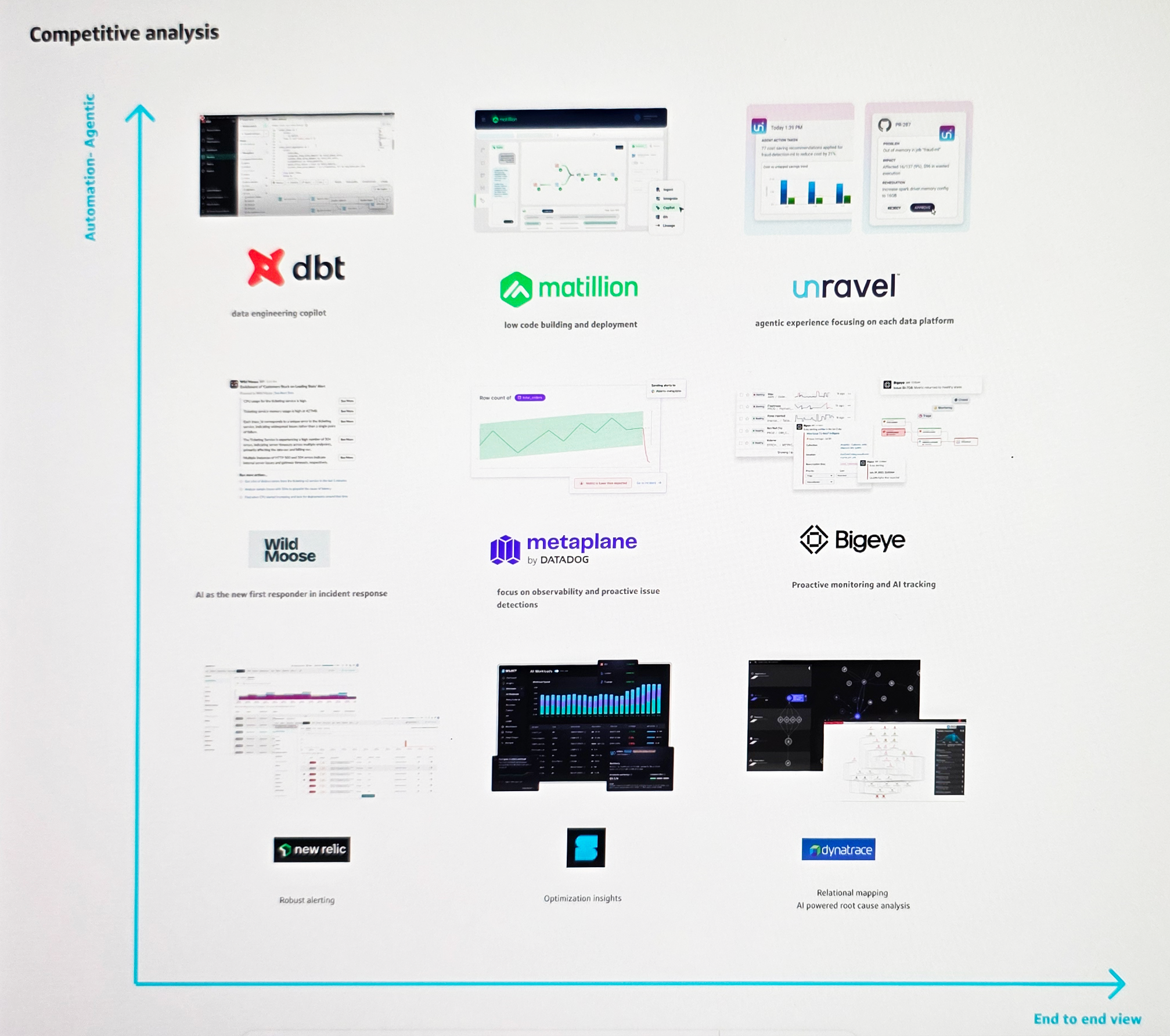
My focus was on:
How existing products reason under complexity
Where they break down at scale
What AI maturity tier they actually operate in (automation vs agentic)
What gaps users were forced to solve outside the platform
This analysis directly informed what not to build, helping avoid chat-only and automation-only patterns that competitors relied on but users struggled with.
User & System Analysis (Reality Check)
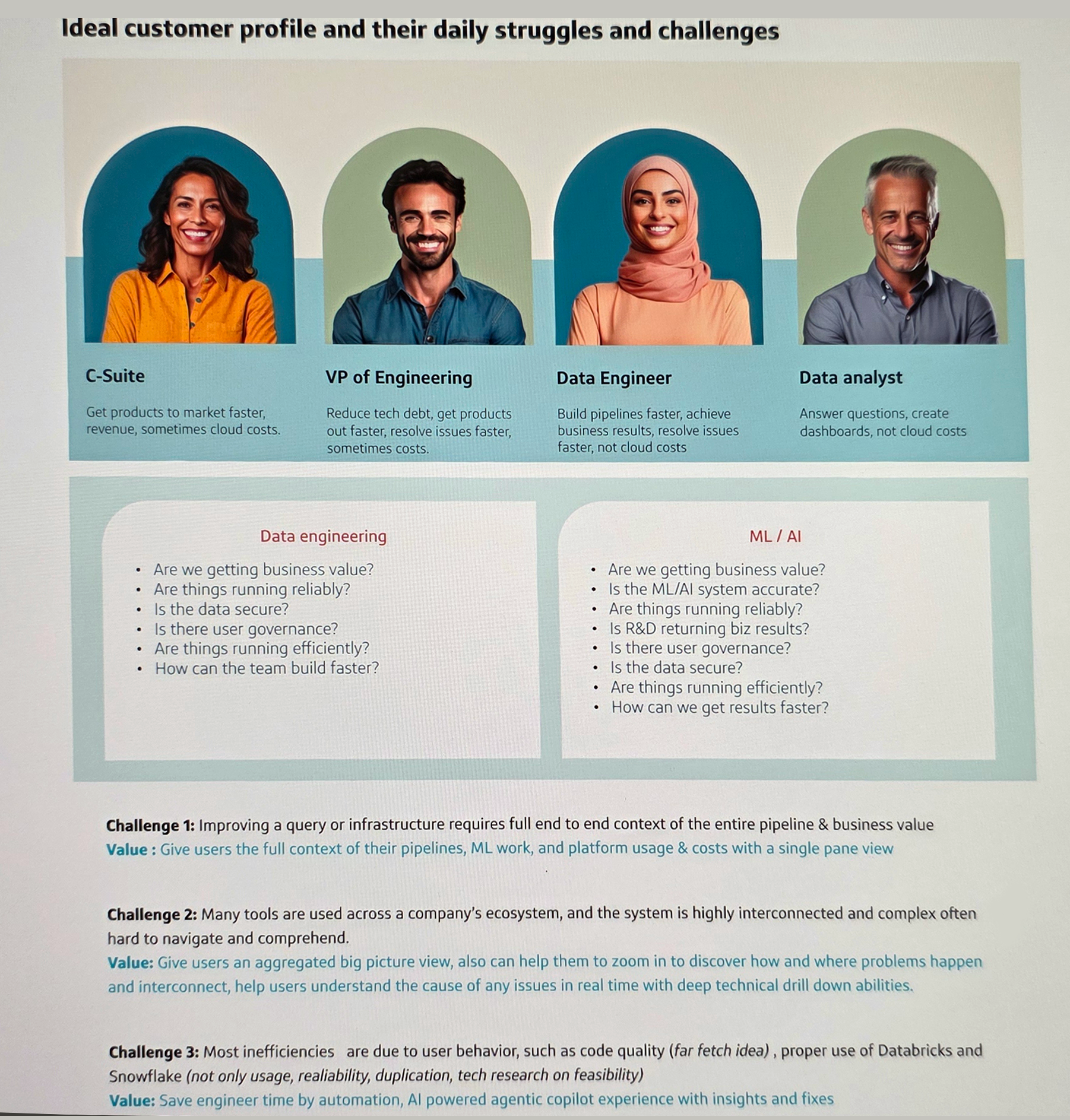
In parallel, I analyzed real user workflows across Data Analysts, Cloud Platform Managers, and Executive stakeholders, focusing on both human and system behavior. Key insights: Users were not explicitly asking for “AI,” but for faster problem resolution and better visibility Existing workflows were manual, fragmented, and reactive Competitors offered proactive signals, but lacked context, trust, and actionability Users were frequently forced to: Switch between multiple tools to run logs, edit results, and generate reports Build internal stop-gap solutions to compensate for product gaps Rely on desktop-based tooling despite expectations for cloud-native platforms These insights highlighted a clear opportunity for context-aware, integrated intelligence rather than isolated AI features.
Target Audience:
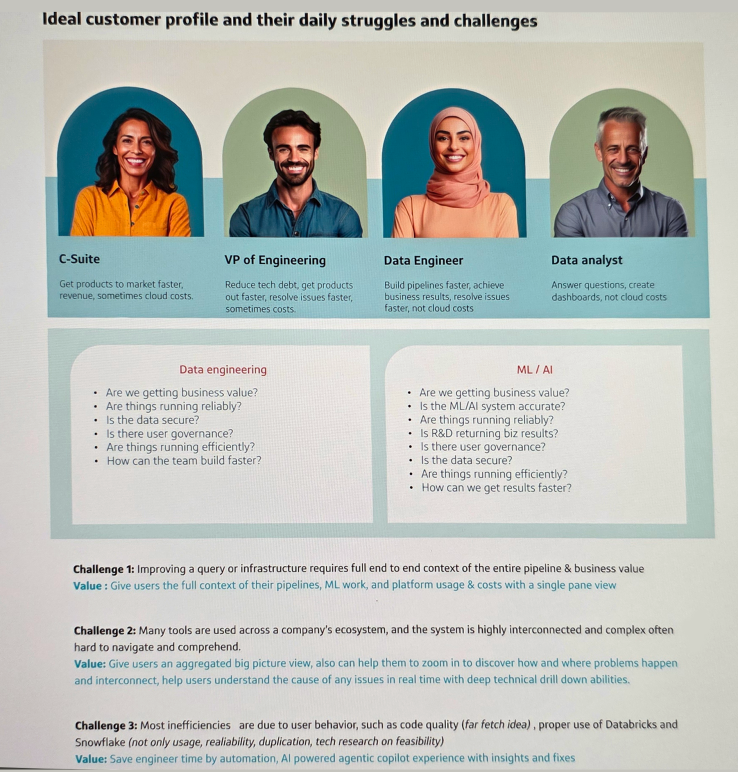
- Primary Users: Data Analysts, Cloud Platform Managers, VP of Engineering/Infrastructure.
Discovery Insights from previous research:
- Users weren’t explicitly demanding “AI,” but wanted faster problem resolution and better visibility.
- Current workflows involved tedious manual exploration.
- Market competitors were advancing in proactive AI-driven insights (DBT, Matillion, Unravel).
User Needs Identified:
- Quickly Identify Outdated or Irrelevant Dashboards
- Gain Real-Time Visibility into Cost Drivers
- Correlate Pipeline Issues Across Complex Data Flows
- Receive Context-Aware, Proactive Recommendations
- Stay in Control of AI Suggestions and Actions
- Persona-Tailored Insights (Analysts vs Executives)
- Integrate Seamlessly into Existing Workflows
High Impact AI usecases Identified
To avoid generic AI exploration, I aligned closely with executive stakeholders and domain experts to prioritize use cases tied to measurable outcomes. This resulted in narrowing many exploratory ideas down to three flagship AI use cases:
Query Optimization
- Diagnose inefficient queries
- Explain causes using execution + lineage context
- Recommend optimizations
- Compare before/after impact
Duplicate Pipelines
- Identify redundant pipelines
- Reason across usage, lineage, and cost
- Recommend consolidation opportunities
Root Cause Analysis
Root cause analysis is for Phase 2 MVP with conversation and agentic AI, as RCA needs deeper back-to-back questions to get to the cause
Key Learnings
- Competitors marketed “AI,” but operated at low maturity (automation or summarization).
- Users didn’t want AI features—they wanted faster diagnosis and safer decisions.
- Existing workflows were fragmented across various tools, resulting in a high cognitive load.
- The biggest opportunity was reasoning across systems, not improving individual tools.
Challenges faced
- No fully ready AI/ML stack at the start
- Ambiguous problem space requiring convergence from broad exploration
- Tight timelines tied to roadmap planning cycles
- Limited engineering capacity for early POCs
Outcome
- AI use cases reduced from many into 3 flagship use cases (Query Optimization, Duplicate Pipelines, Root Cause analysis)
- Reduced ambiguity and accelerated roadmap decisions by converging on high-value, buildable AI problems
- Established the foundation for Slingshot’s 2026 AI roadmap
- Executive sign-off on AI direction, Time to alignment reduced (qualitative)
Design Decision Framework
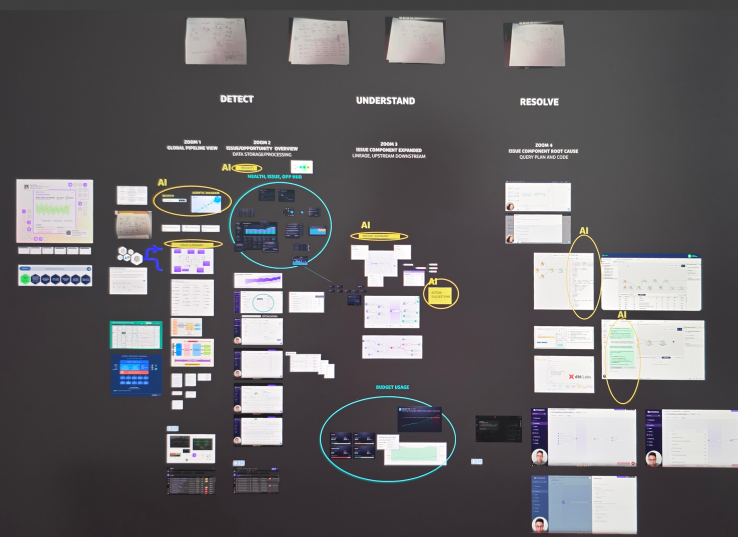
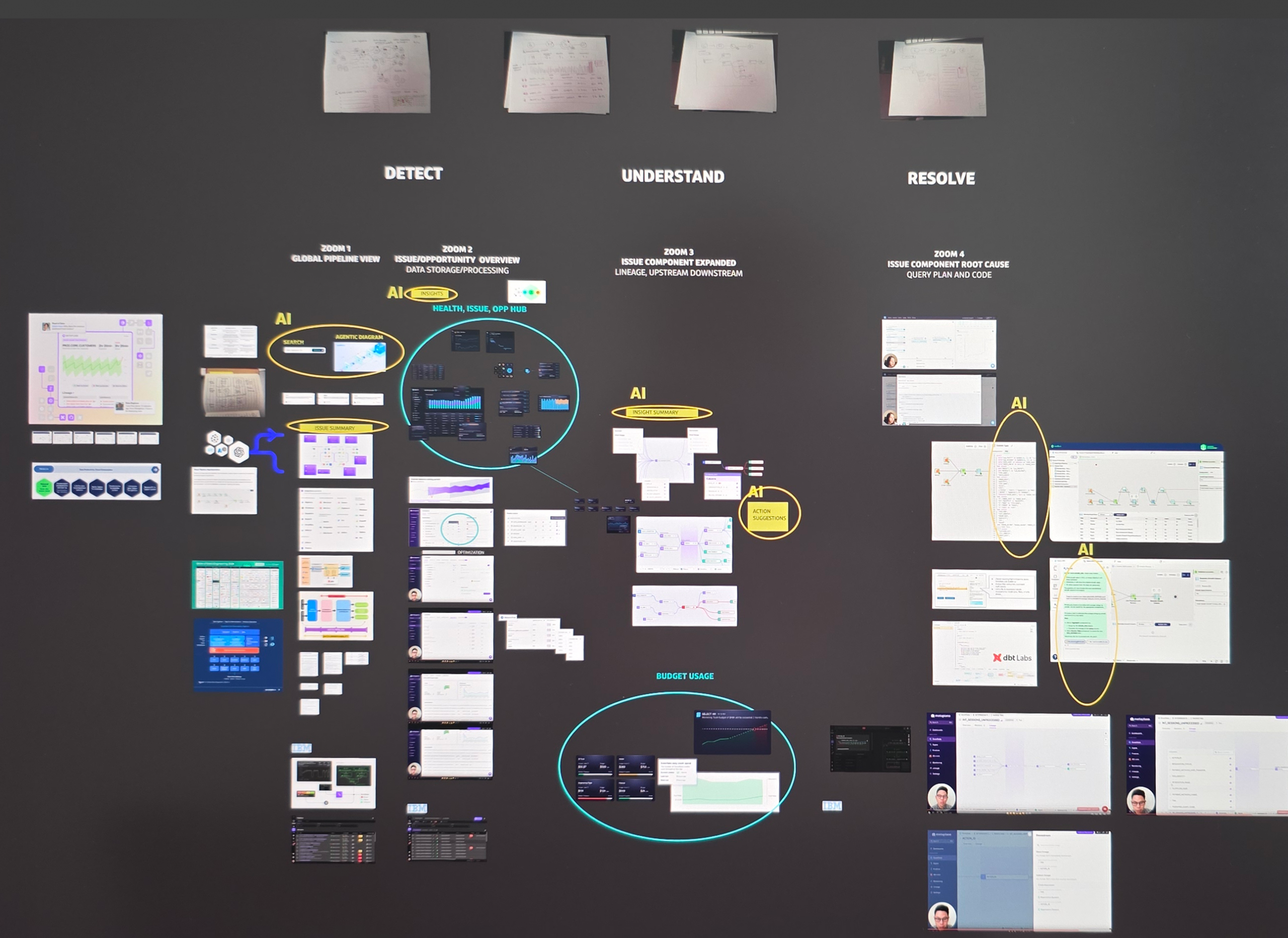
To synthesize findings, I mapped research insights into a design decision framework aligned with Slingshot’s product structure:
Detect → Understand → Resolve
This framework allowed competitive insights, user needs, and system constraints to converge into actionable AI opportunities—bridging research and product strategy.
Design
Intelligence and Agent Behavior
Query Optimization
Snowflakes & Databricks
Query optimization was selected as a flagship AI use case because it sits at the intersection of cost, performance, and trust in modern cloud data platforms like Snowflake and Databricks. At enterprise scale, even small inefficiencies in query patterns can multiply across millions of executions—driving excessive compute spend, degrading performance, and creating cascading failures across pipelines and downstream analytics.
In Snowflake and Databricks environments, a query is not just SQL syntax—it is a repeated workload that consumes compute, memory, and I/O, interacts with shared tables and pipelines, and impacts multiple teams over time.
Optimizing queries, therefore, requires understanding:
- How queries execute on Snowflake and Databricks compute engines
- How often they run and who depends on them
- How they interact with tables, pipelines, and downstream workloads
- How cost, performance, and reliability trade off in real systems
Tech POC confirmed, the optimization agent performs better than the Snowflake Cortex AI :
- It has a clear, measurable impact (cost + performance)
- It is high risk if done incorrectly
- It requires deep context across systems, not just SQL syntax
- It directly affects multiple personas (admins, engineers, analysts)
This made it an ideal proving ground for context-aware, explainable AI.
Query optimization is a system-level problem, not just a syntax problem—and why it’s ideal for context-aware and agentic AI.
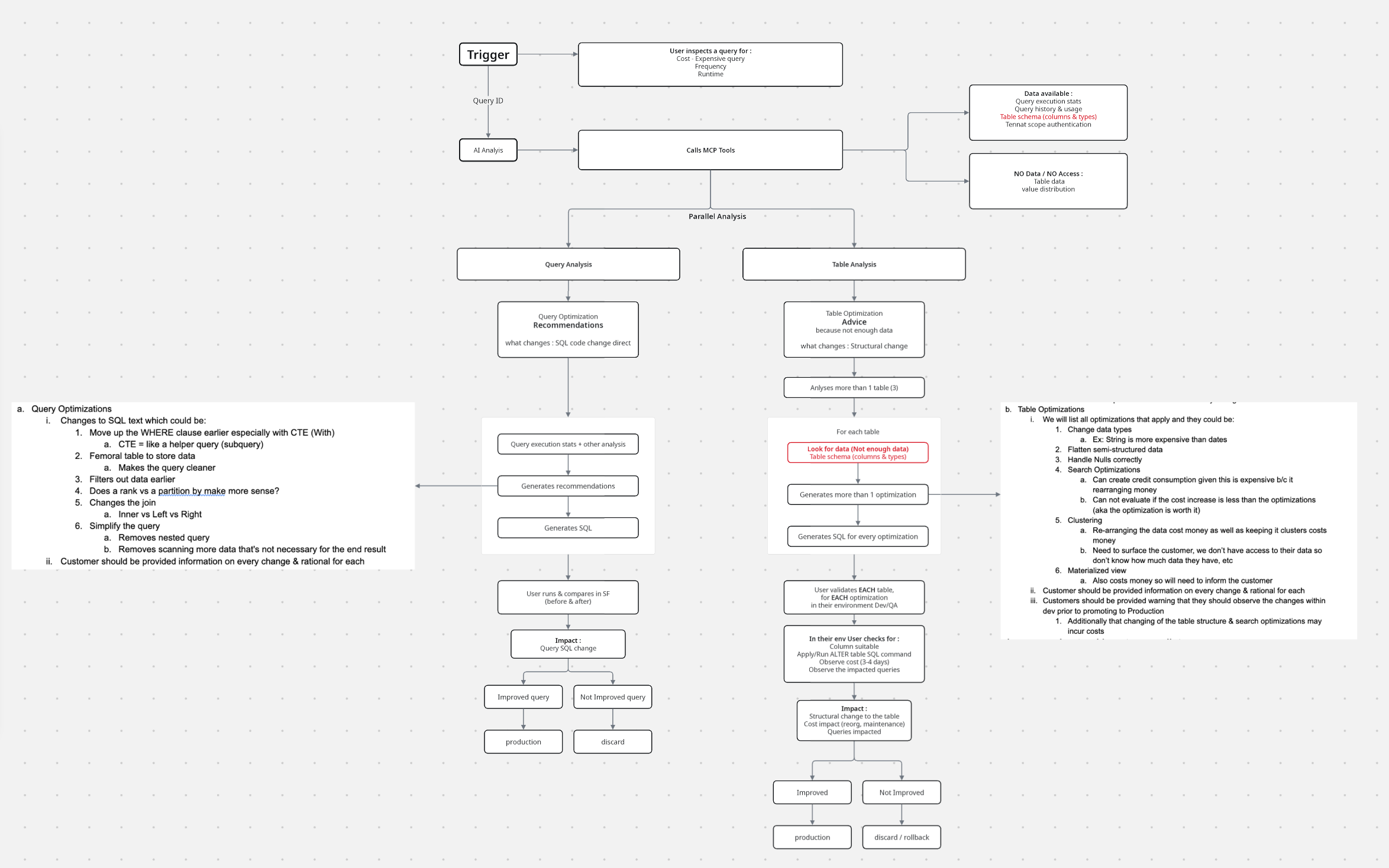
How is a query optimization insight generated by context aware AI ?
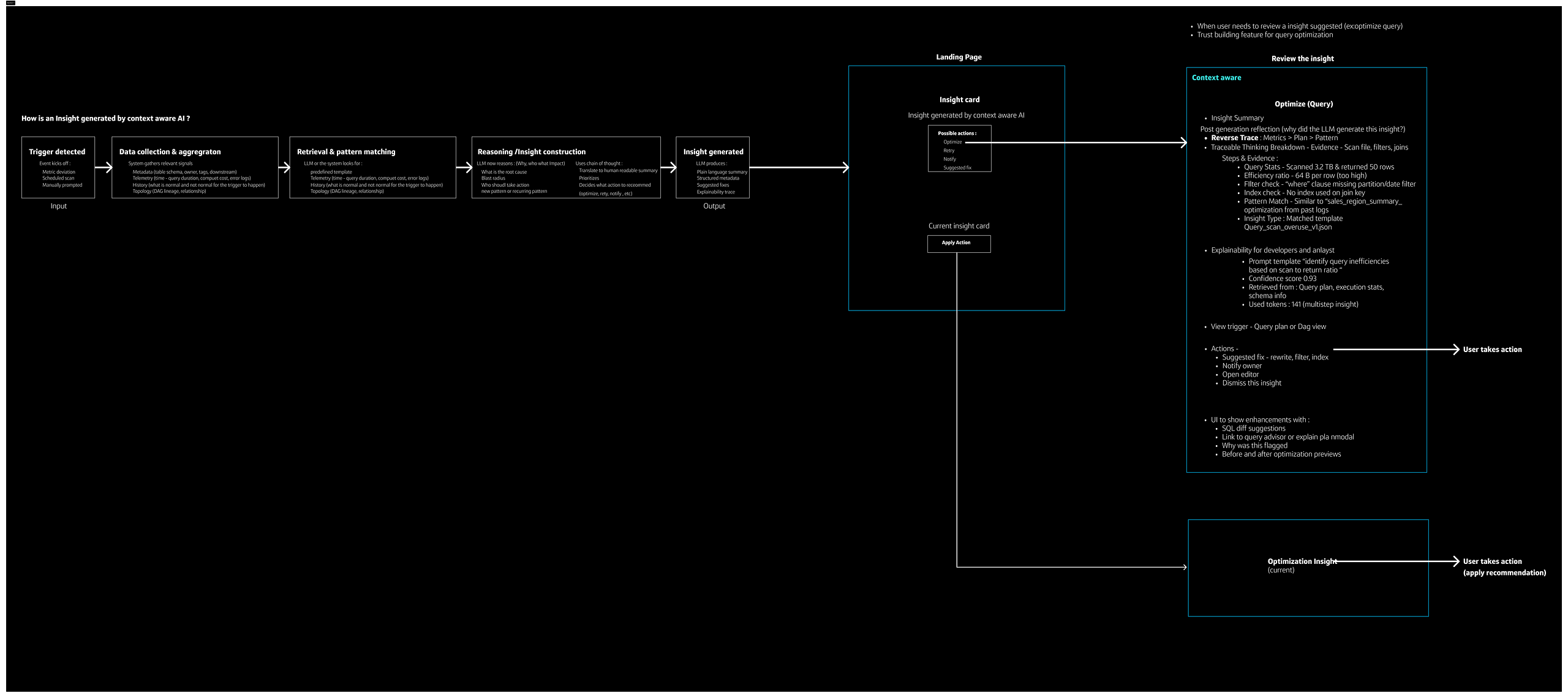
Key Experiences & System Touchpoints I Designed
I designed the core experiences that define how users interact with Slingshot’s context-aware AI system. These interfaces evolved through whiteboarding, paper prototypes, ai assisted rapid prototypes, wireframes, and iterative visual design — always grounded in system behavior and trust.
Landing Experience
- Proactive detection and prioritization of high-impact issues
- Reduced time spent searching for problems
- Entry point for AI-assisted investigation
Landing Experience
The Landing Experience functions as the sense and triage layer of the agentic system. It continuously aggregates signals across queries, pipelines, workloads, cost telemetry, and performance trends to surface the highest-impact candidates for investigation. Issues are algorithmically ranked by cost impact, execution degradation, and operational risk—allowing the system to initiate analysis rather than relying on manual discovery. This creates a deterministic, explainable entry point into AI-assisted reasoning, optimization, and validation.
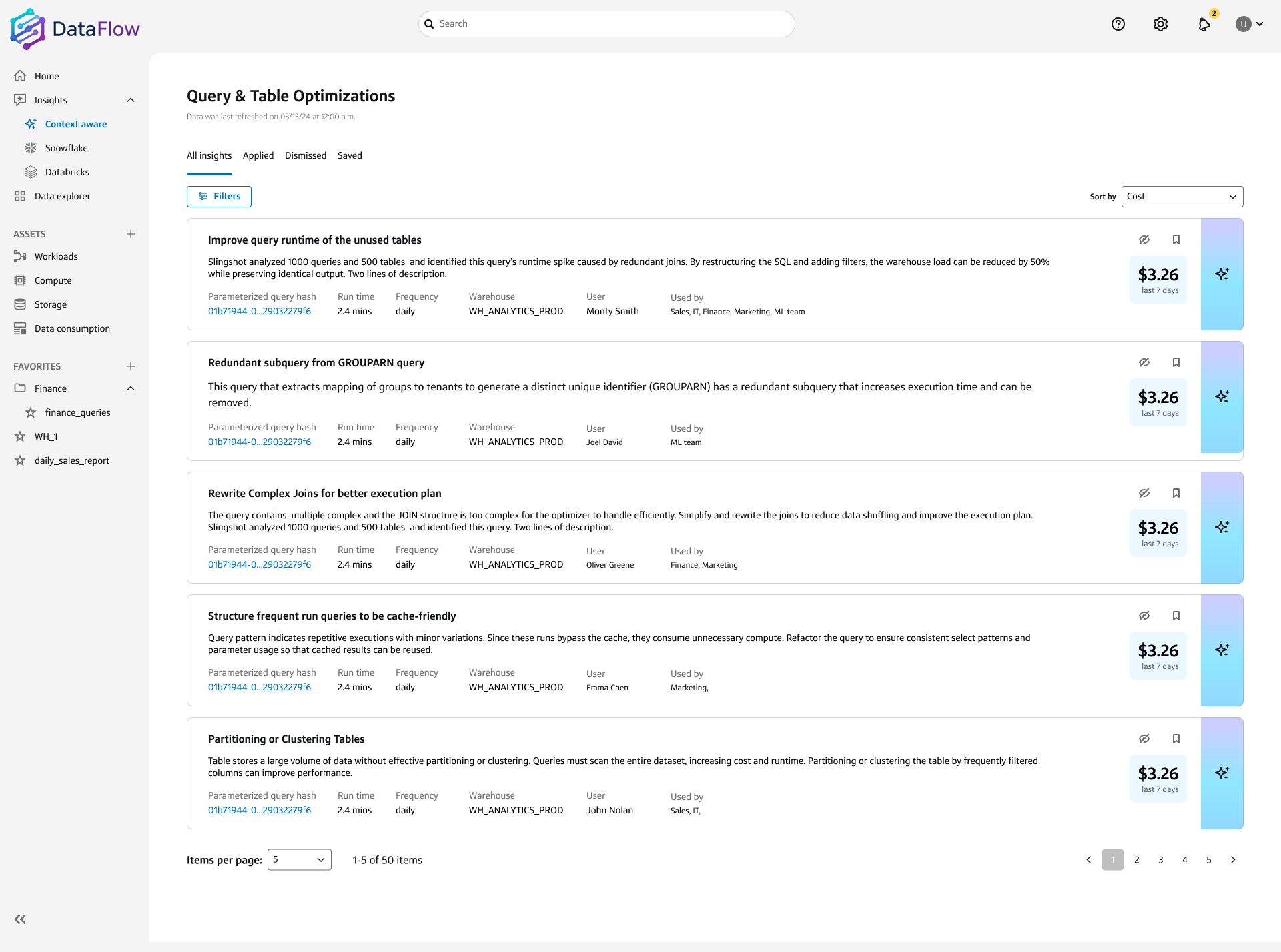
Insights Hub
The Insights Hub serves as the system’s prioritization and orchestration layer. It consolidates detected issues into a unified surface, ranking queries and pipelines by cost magnitude, frequency, trend change, and blast radius.
By grounding prioritization in observable signals and system context, the hub reduces noise and directs attention to optimization opportunities with the highest potential impact—replacing fragmented dashboard scanning with a single, context-aware decision surface.
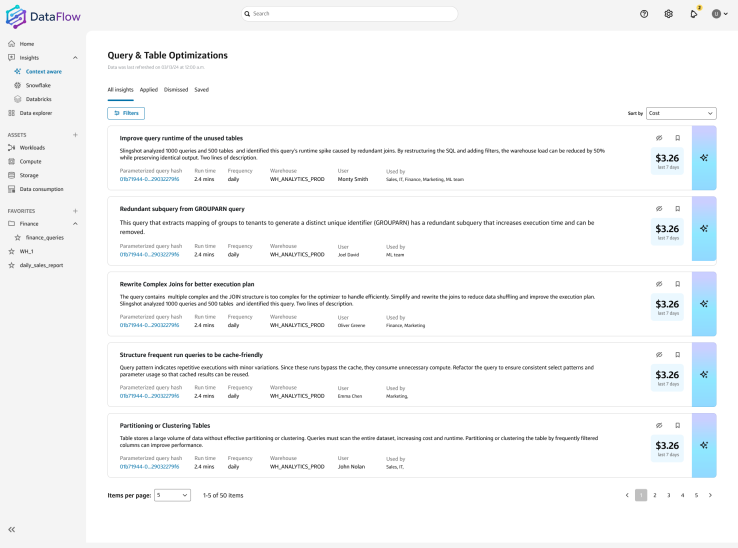
Landing Page
Insights Details
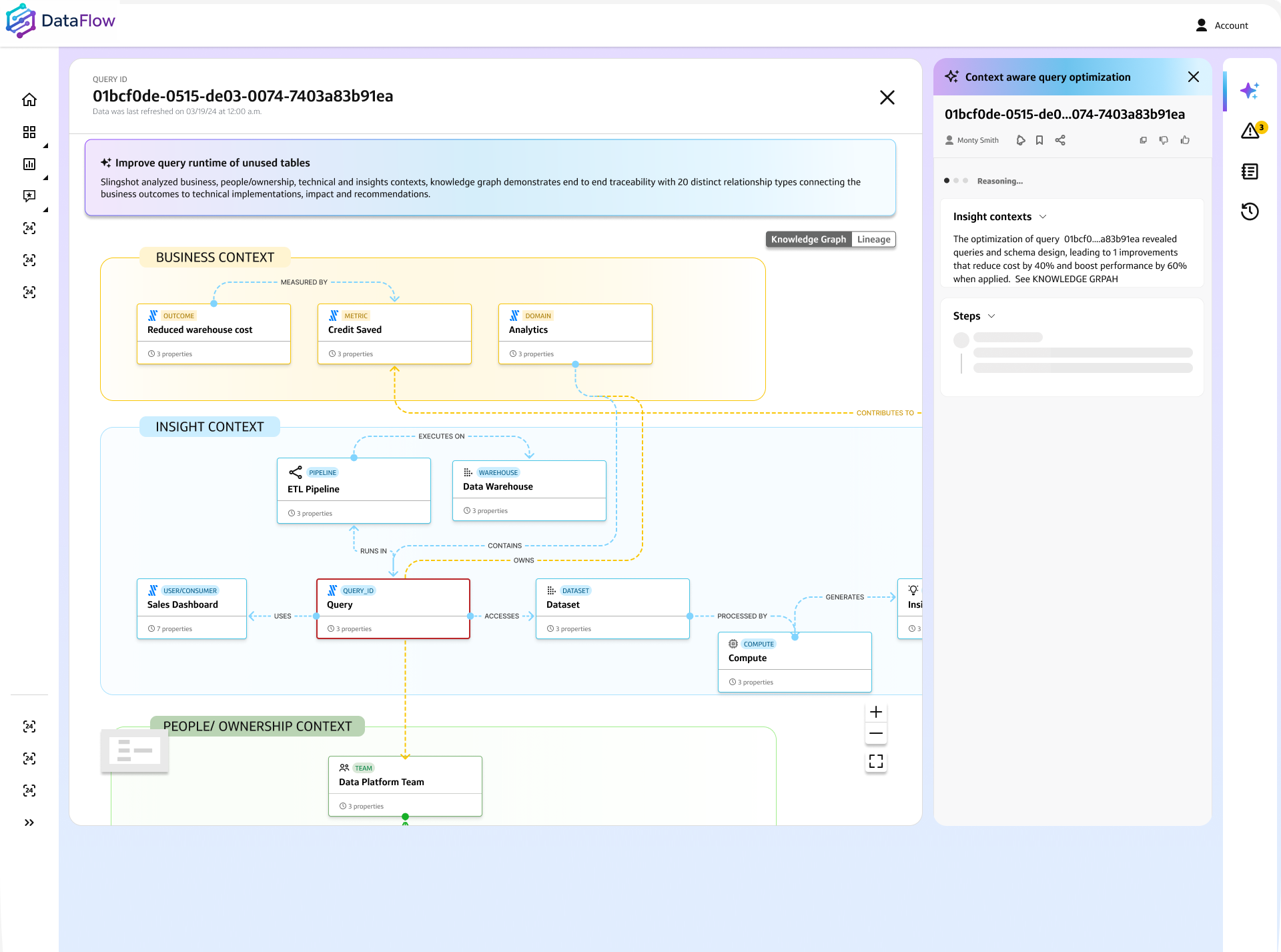
The Insight Details view exposes the system’s diagnostic reasoning. It brings together execution behavior, cost attribution, lineage dependencies, and historical patterns to explain why an issue was flagged and how it affects the broader ecosystem.
Evidence is surfaced alongside recommendations to support human-in-the-loop validation, enabling users to assess risk, verify assumptions, and confidently determine next actions.
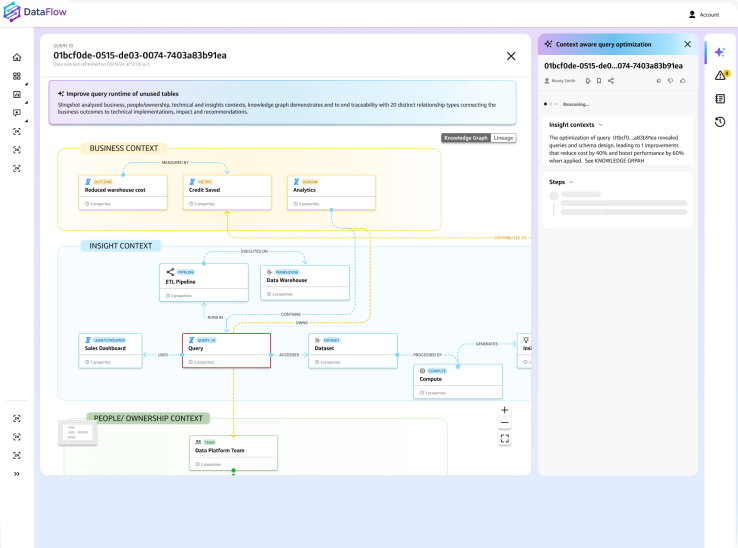
Insights details
Model Structure
A query is an executable instruction—typically written in SQL—that retrieves, transforms, or analyzes data from a data system by specifying what data is needed, how it should be processed, and under what conditions.
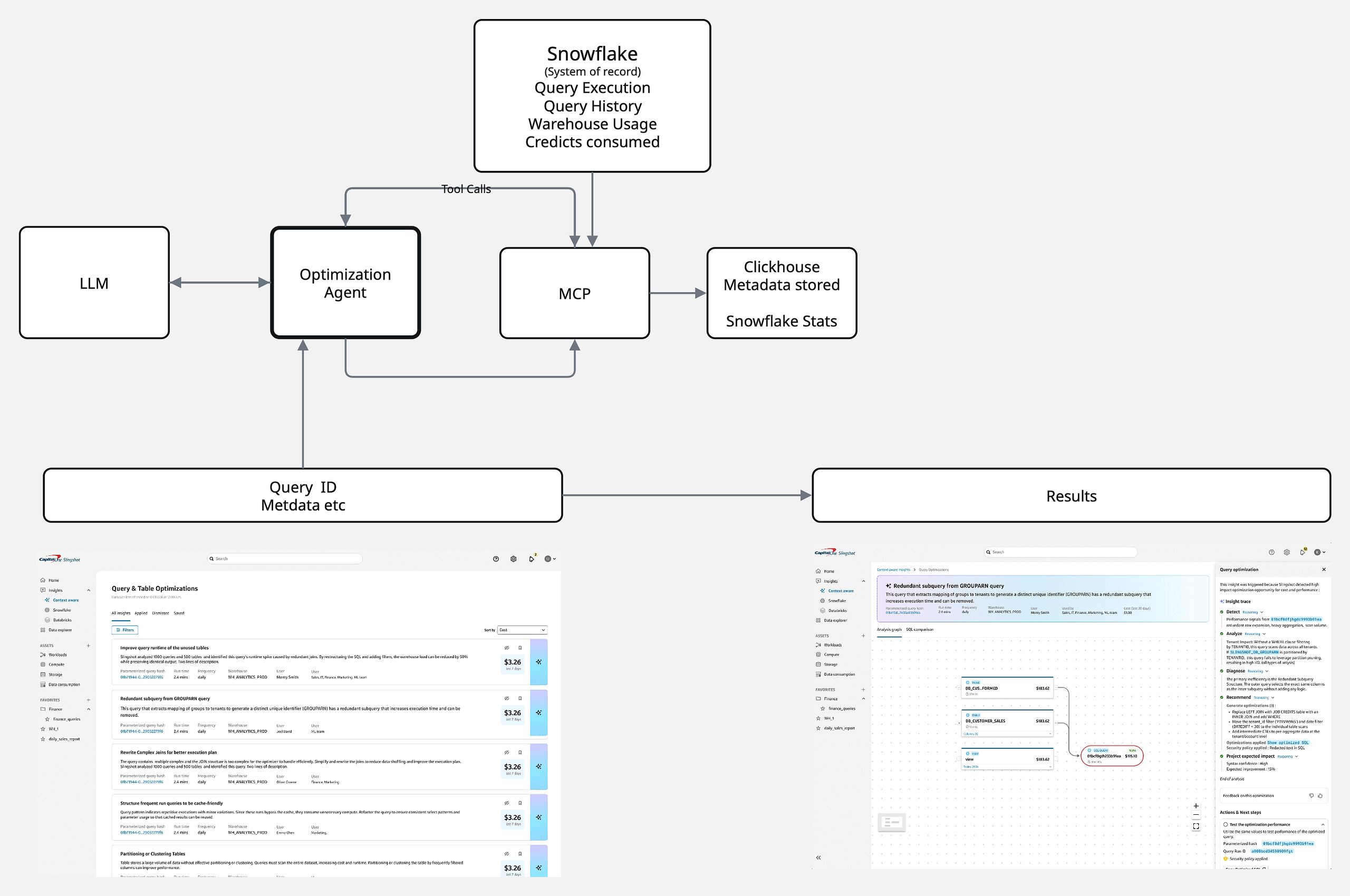
Insights Details & Context & Reasoning
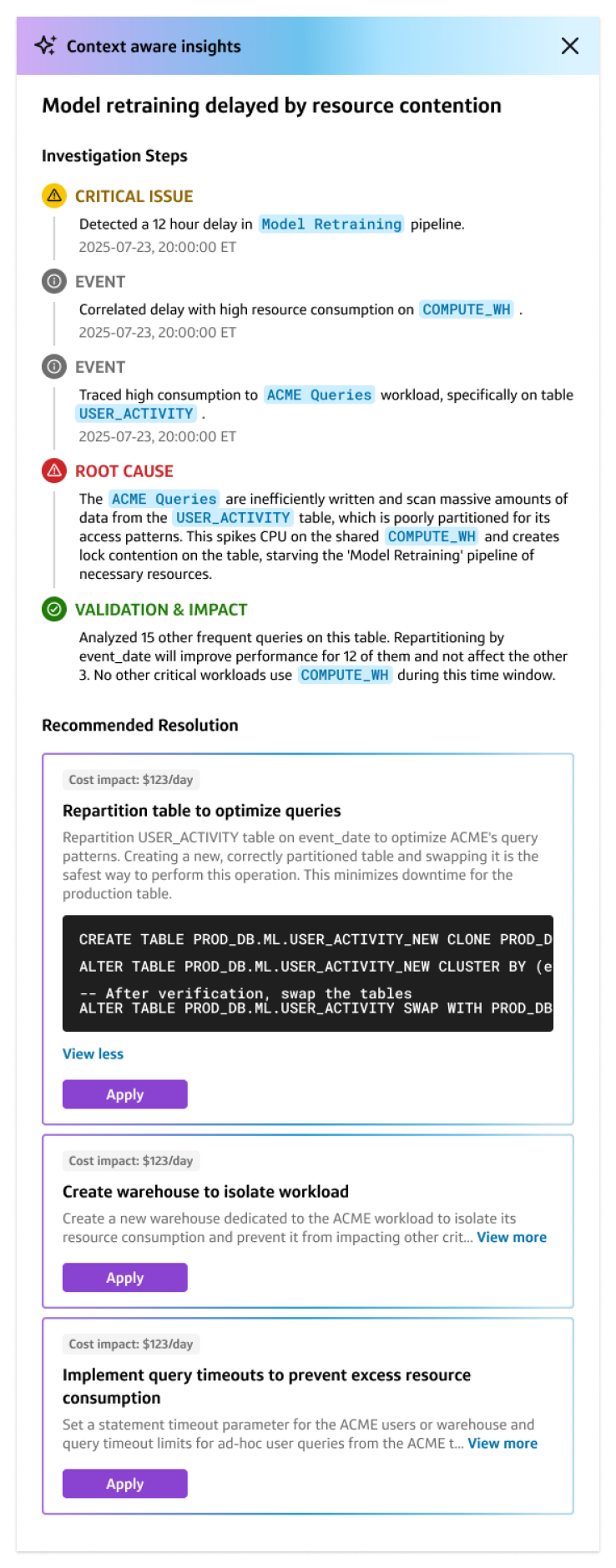
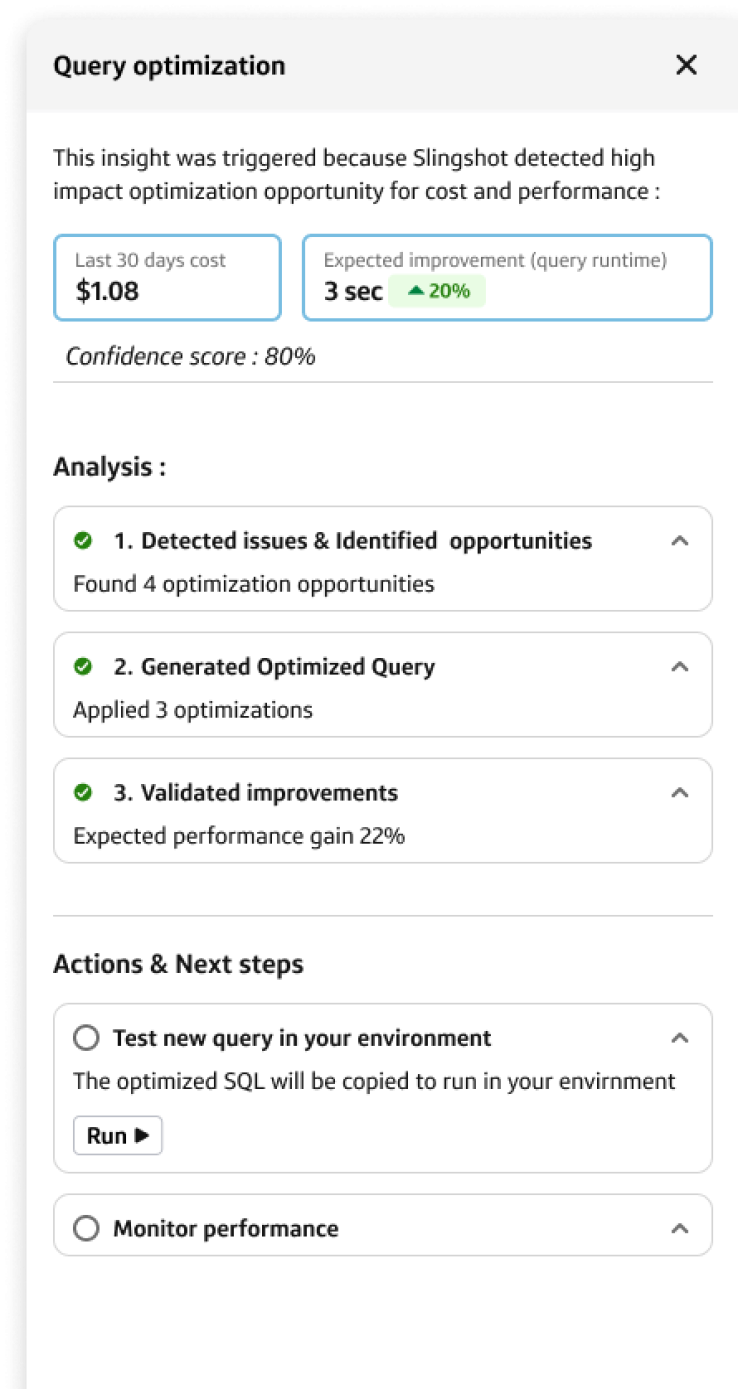
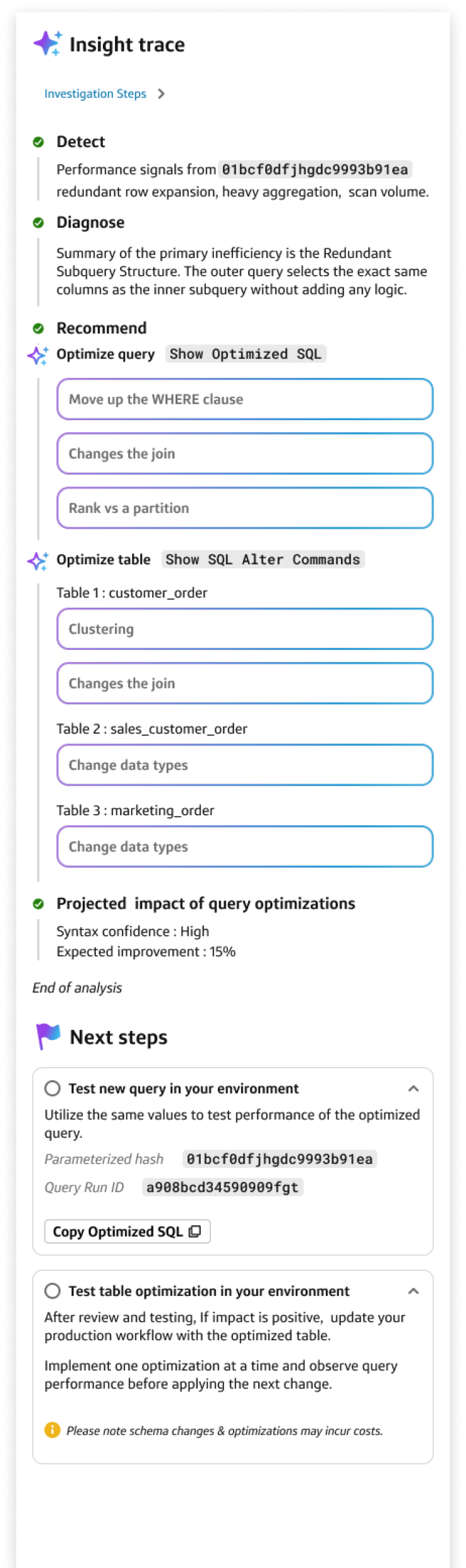
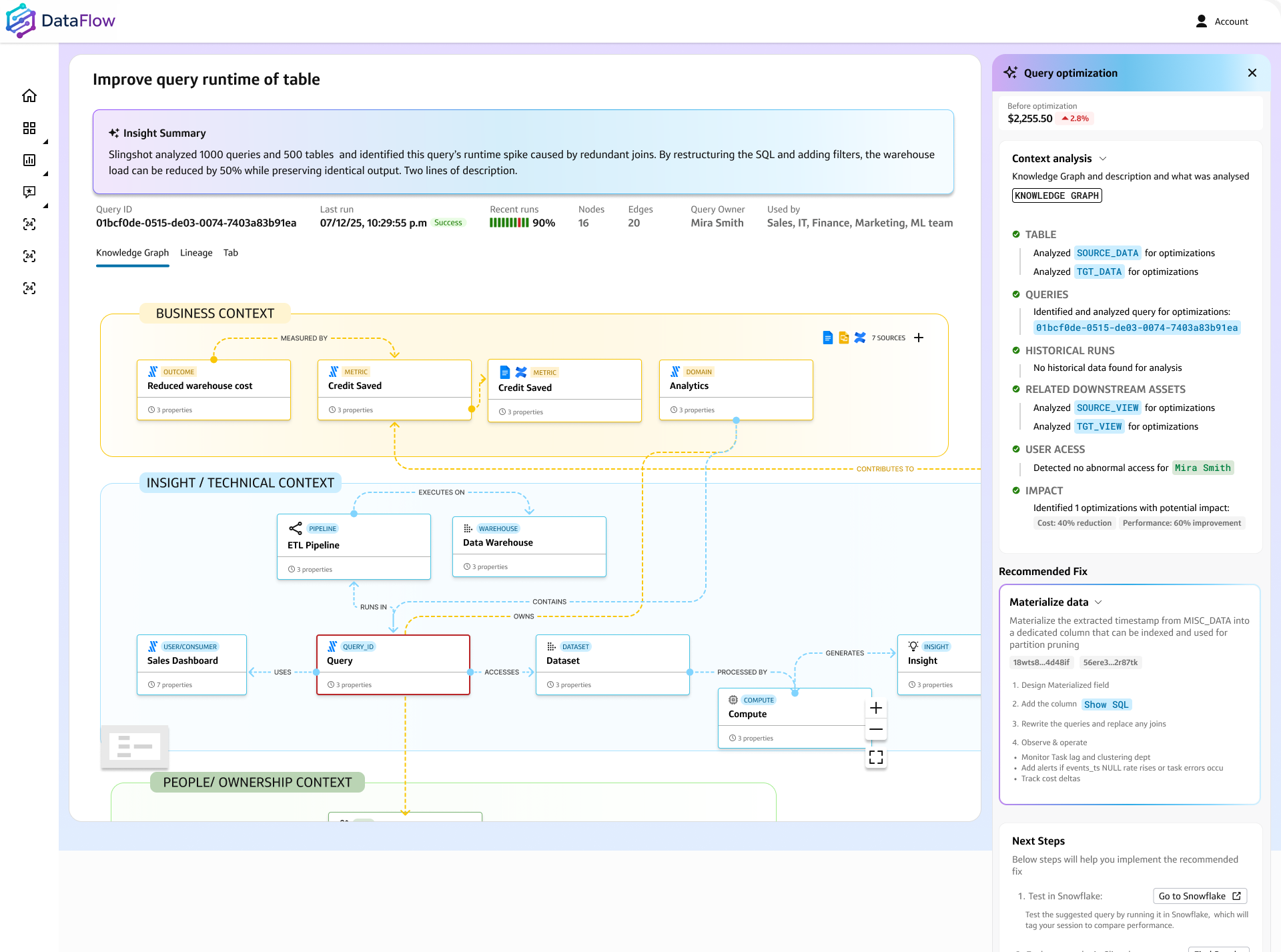
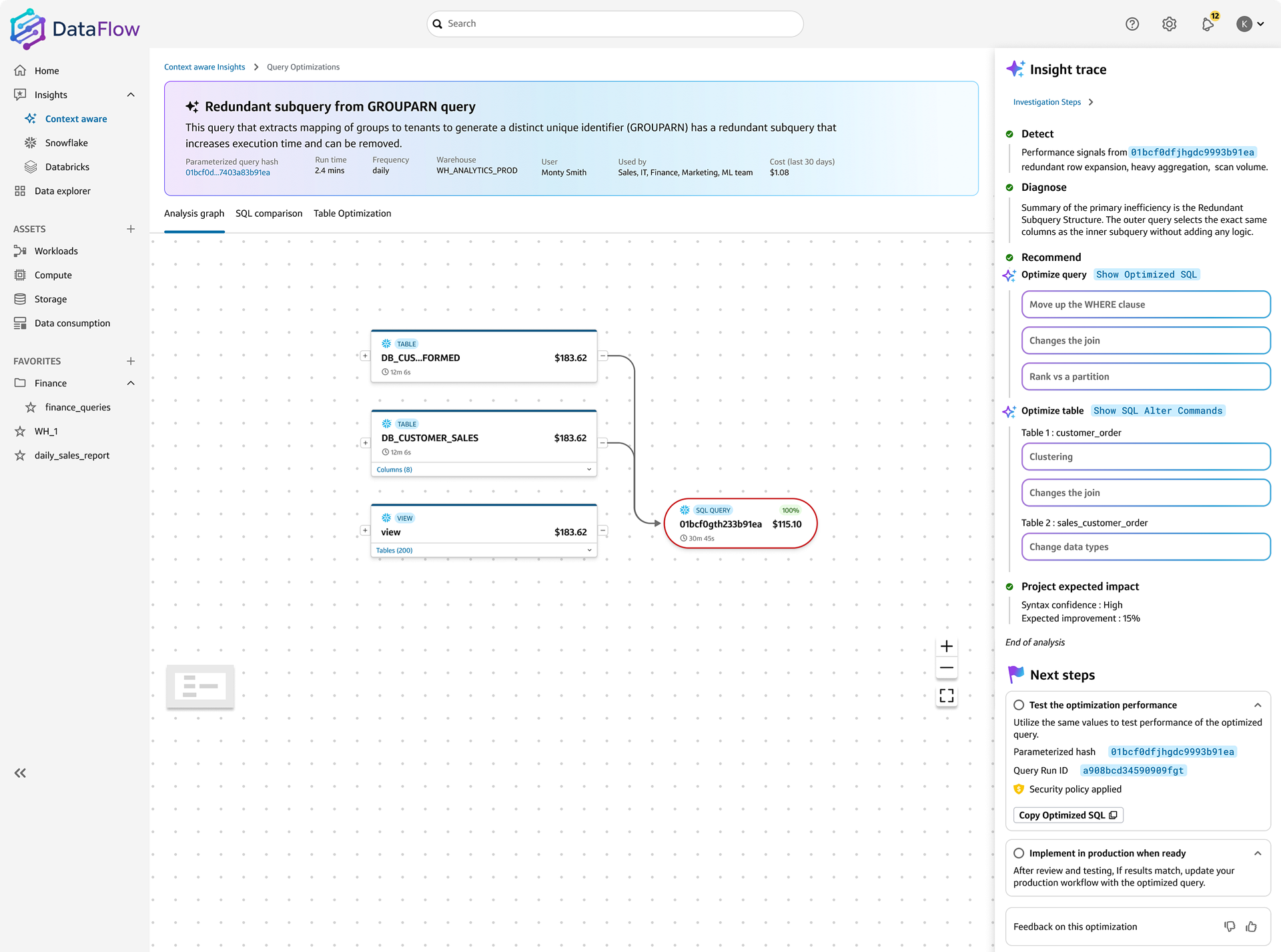
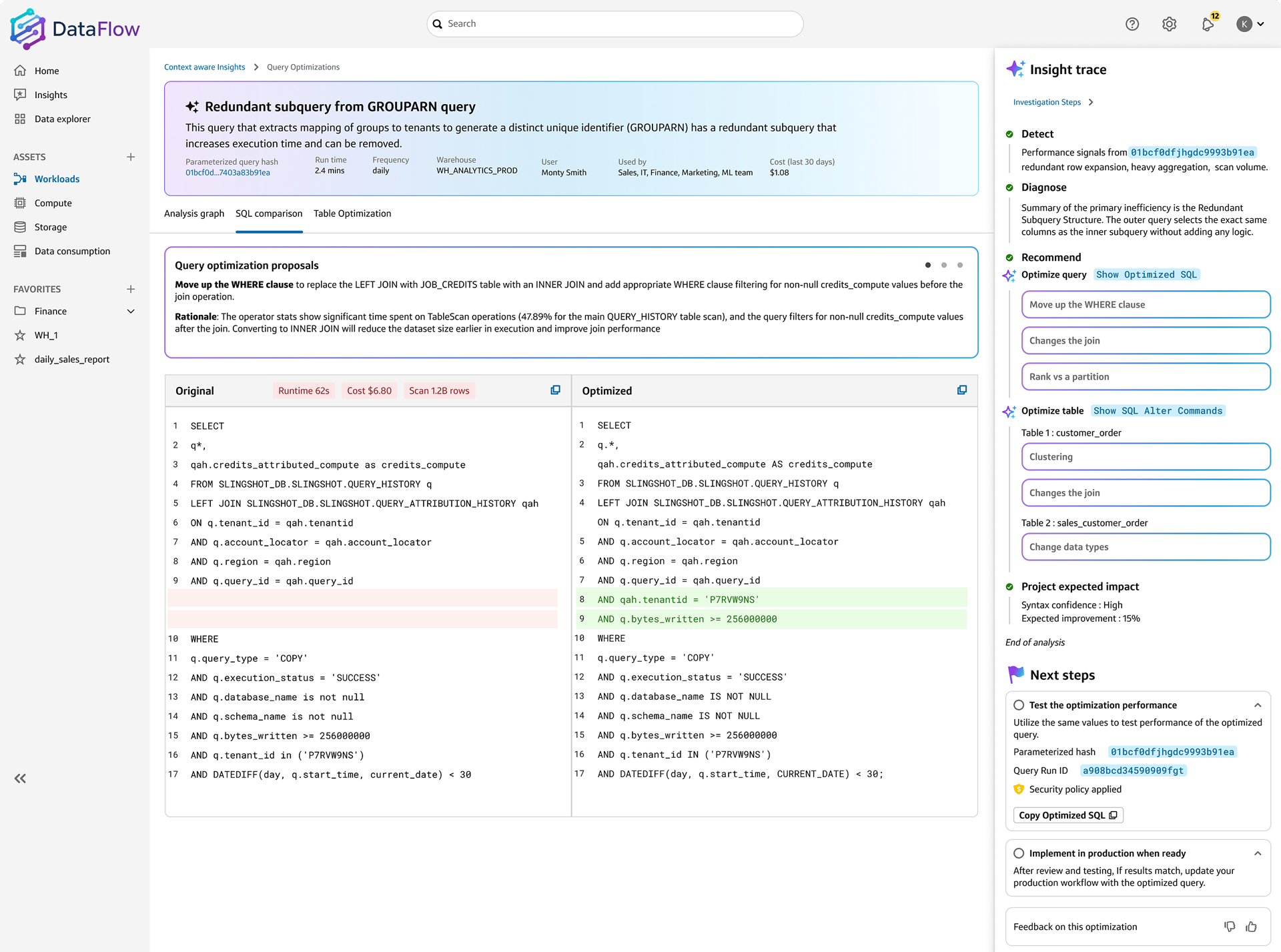
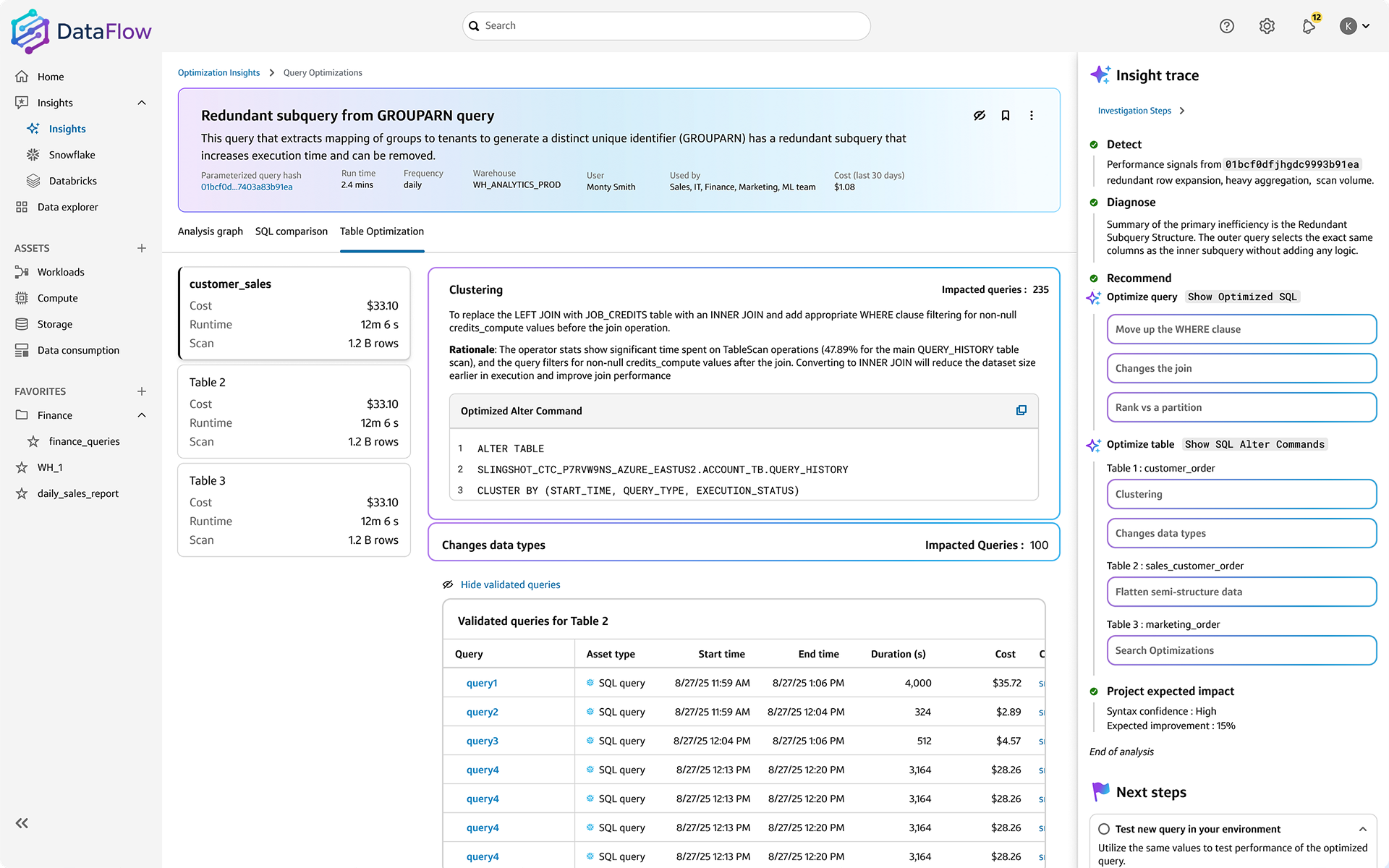
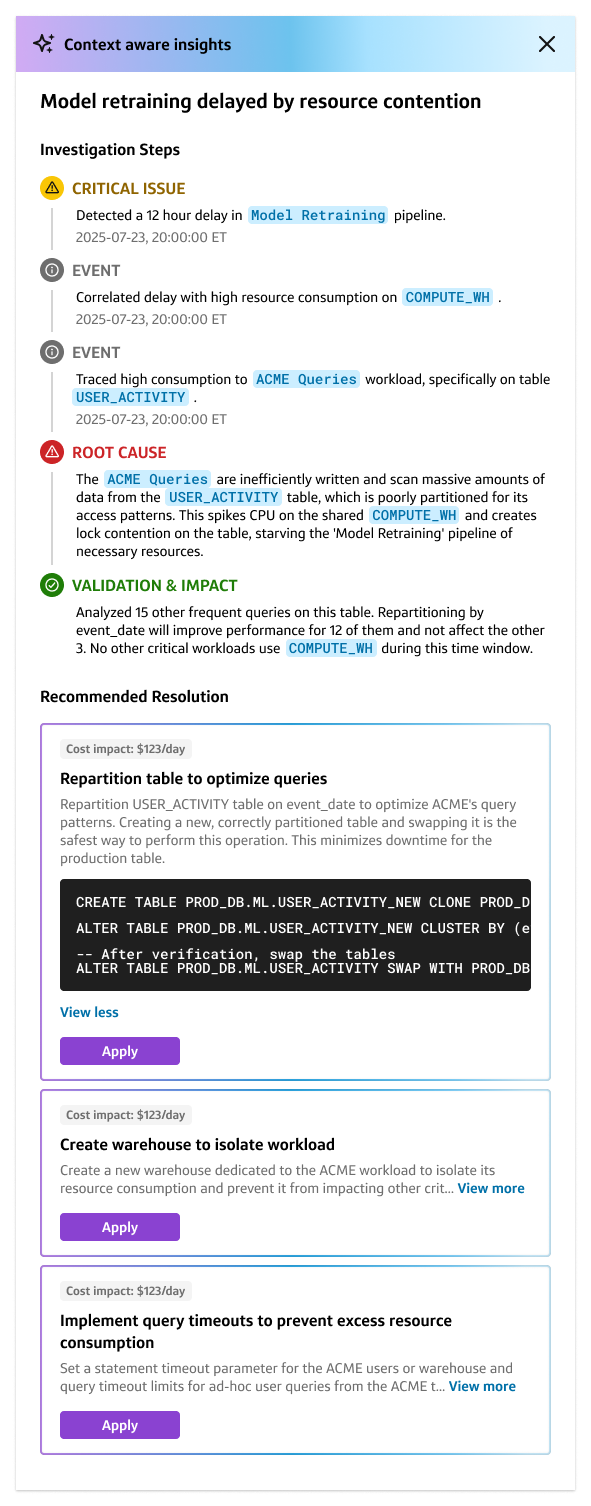
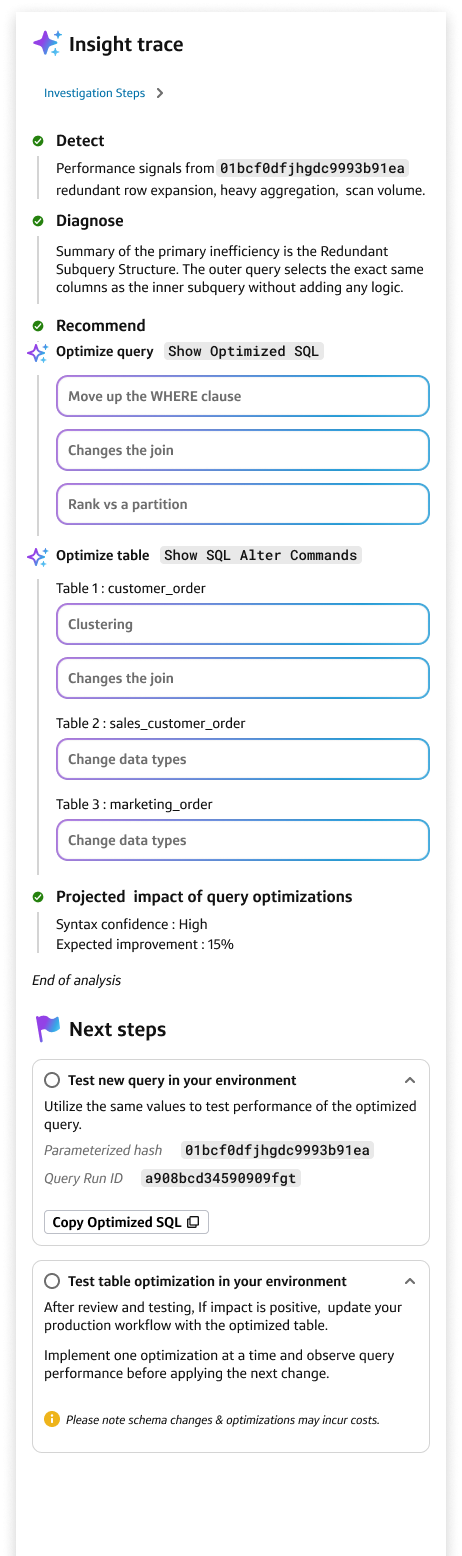
The Insight Details view was designed to surface agentic behavior explicitly—showing how the system gathers context, invokes tools, reasons across evidence, and reaches conclusions. Rather than presenting opaque outputs, it exposes reasoning structure, evidence sources, and decision boundaries to support trust, validation, and human oversight.
Agent reasoning exposed :
Context aggregation (queries, lineage, cost, usage, history), Tool invocation (query analysis, lineage traversal, diff generation), Multi-step reasoning
(detect → diagnose → recommend → validate), Evidence weighting & synthesis
(not just retrieval or summarization), Confidence & uncertainty signaling (eg : Syntax correctness), Action gating (recommend vs execute, approval checkpoints), Traceability
(why this insight, why now), Human-in-the-loop handoff, Non-chat-first interaction model
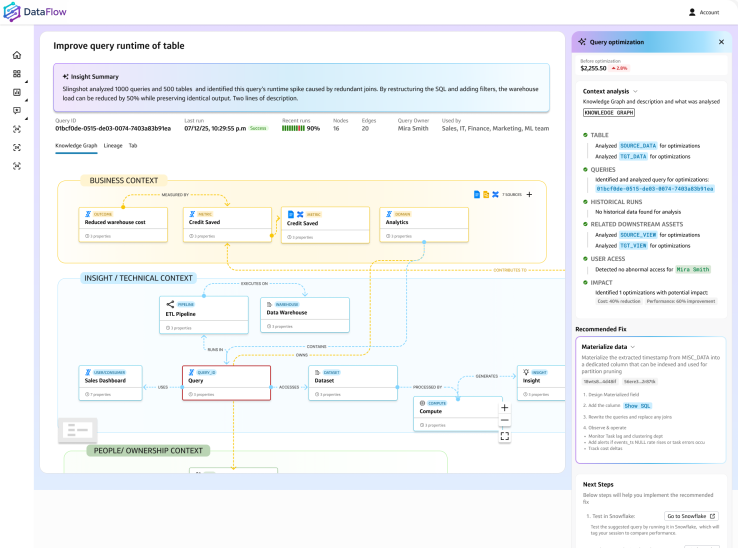
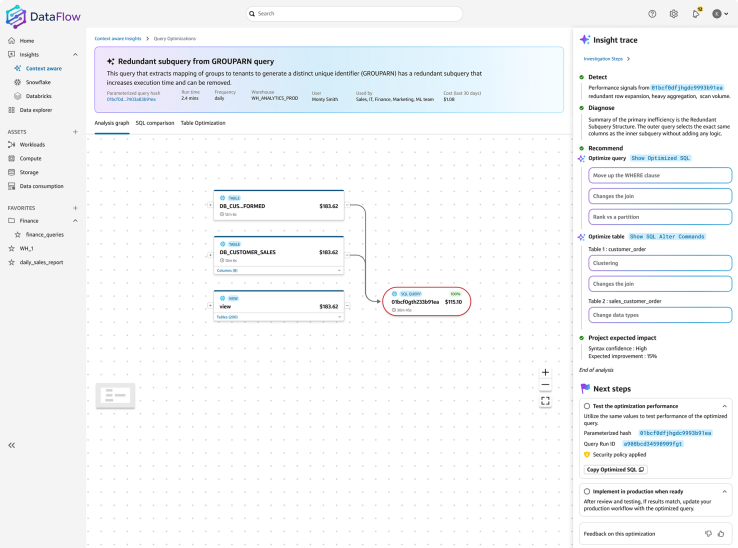
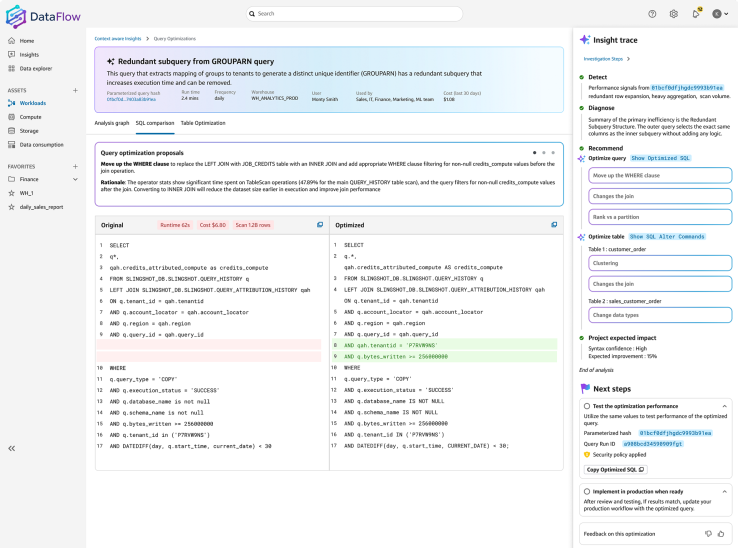
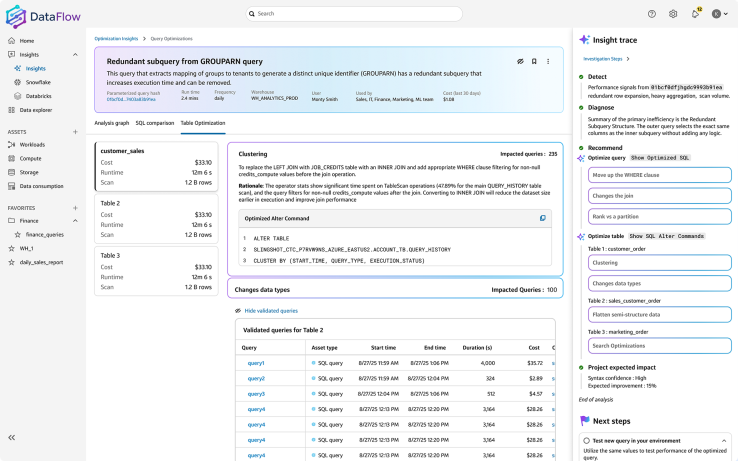
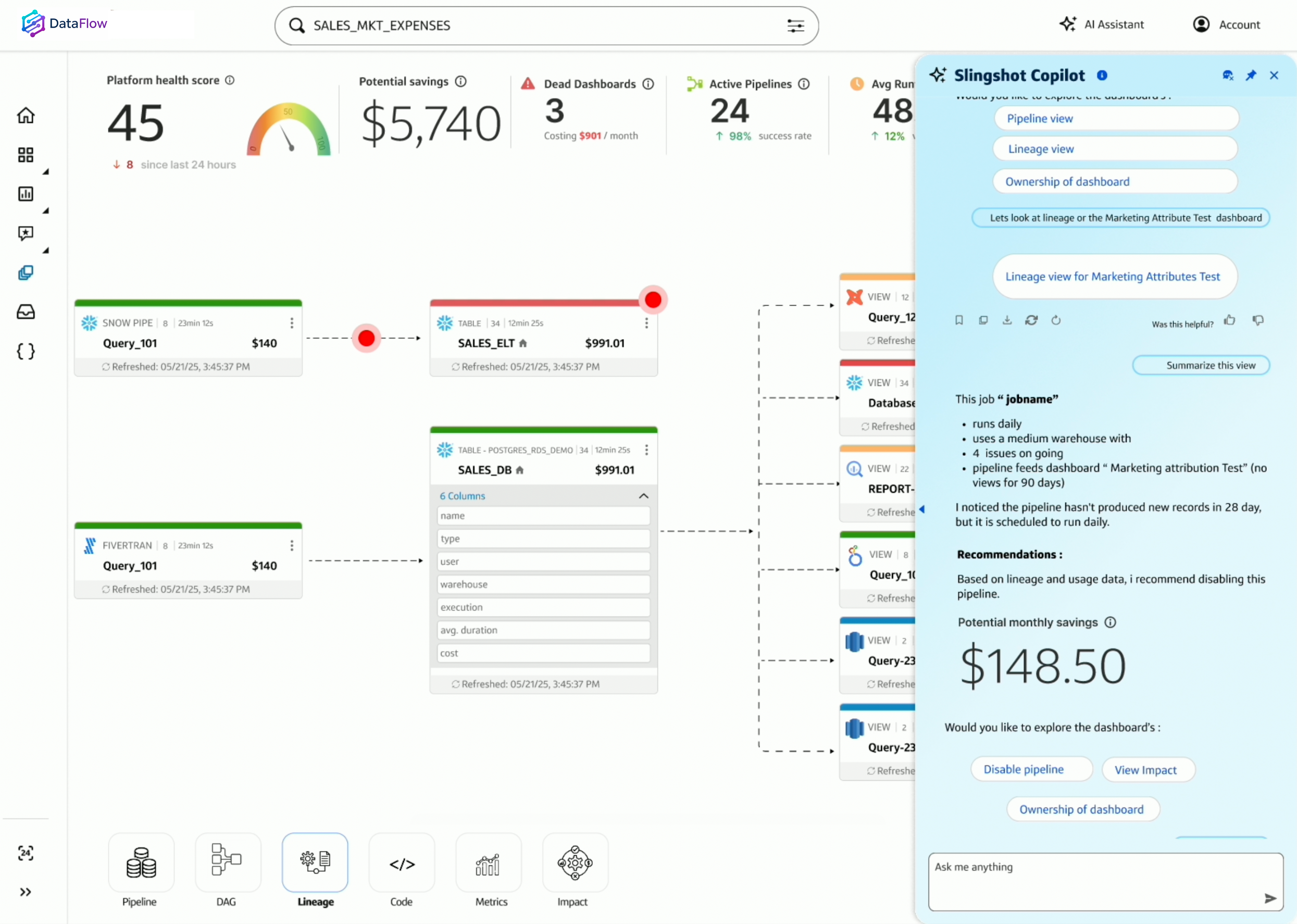
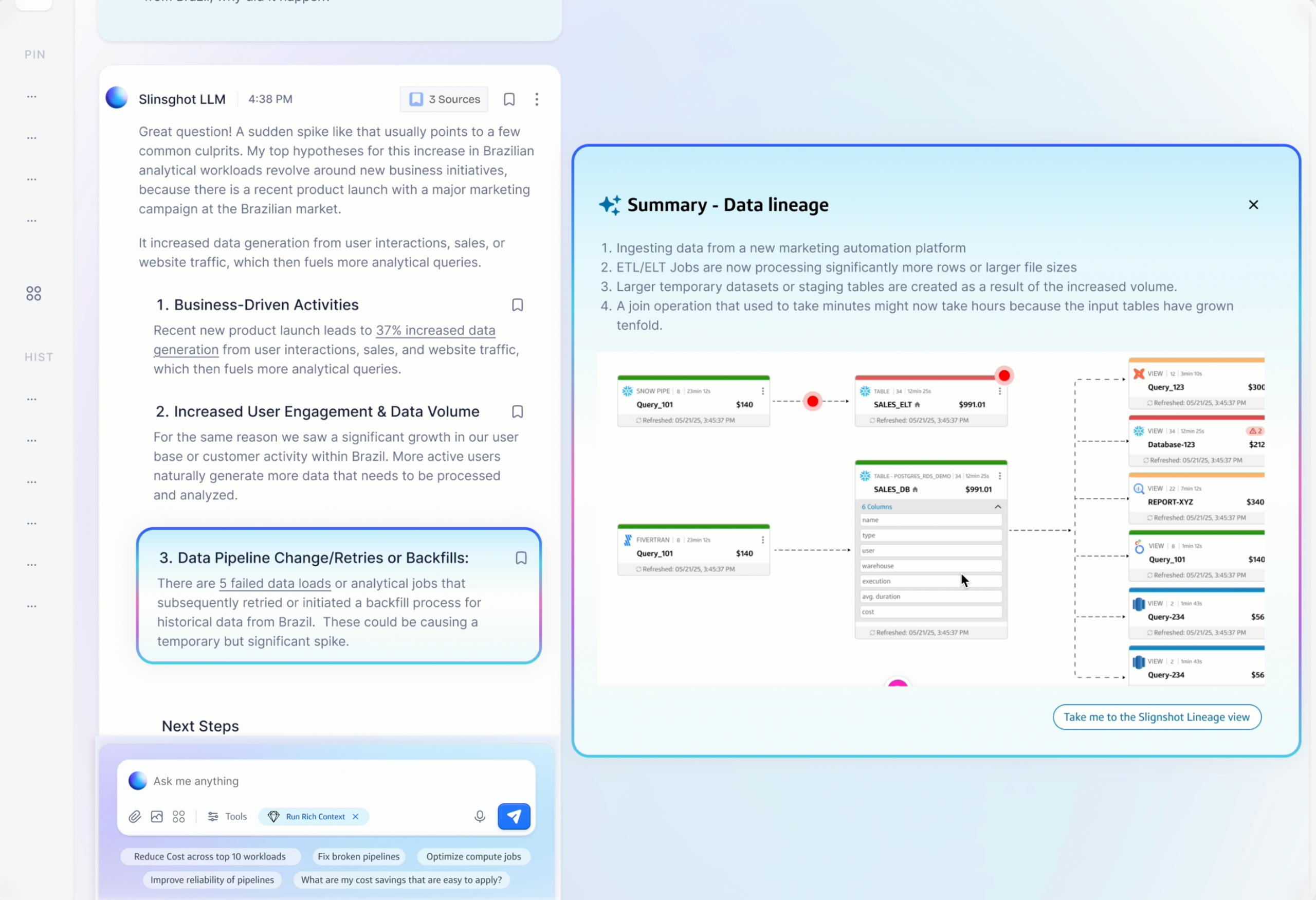
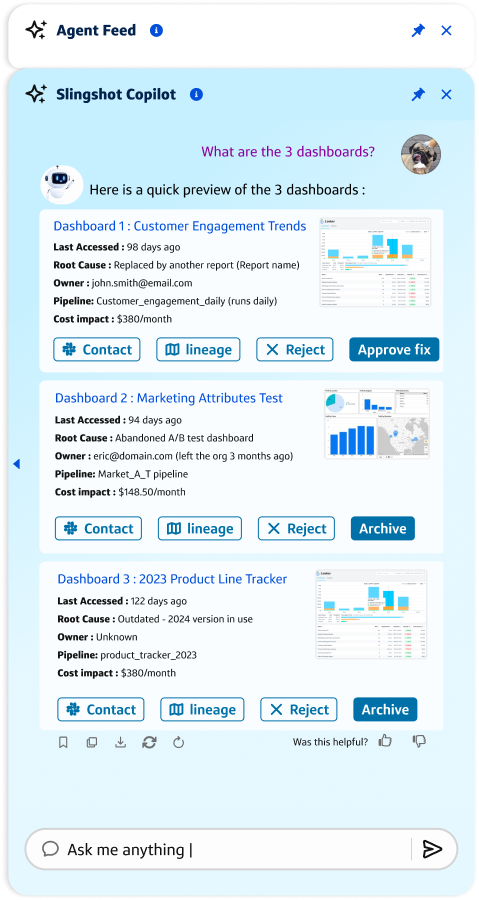
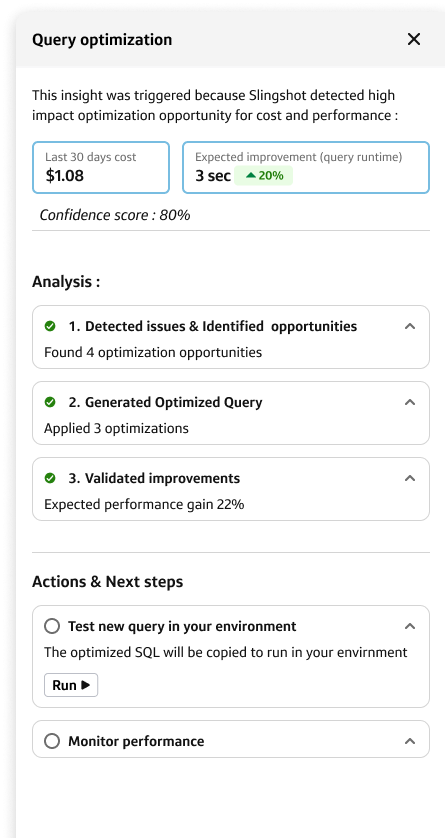
Agent side panel
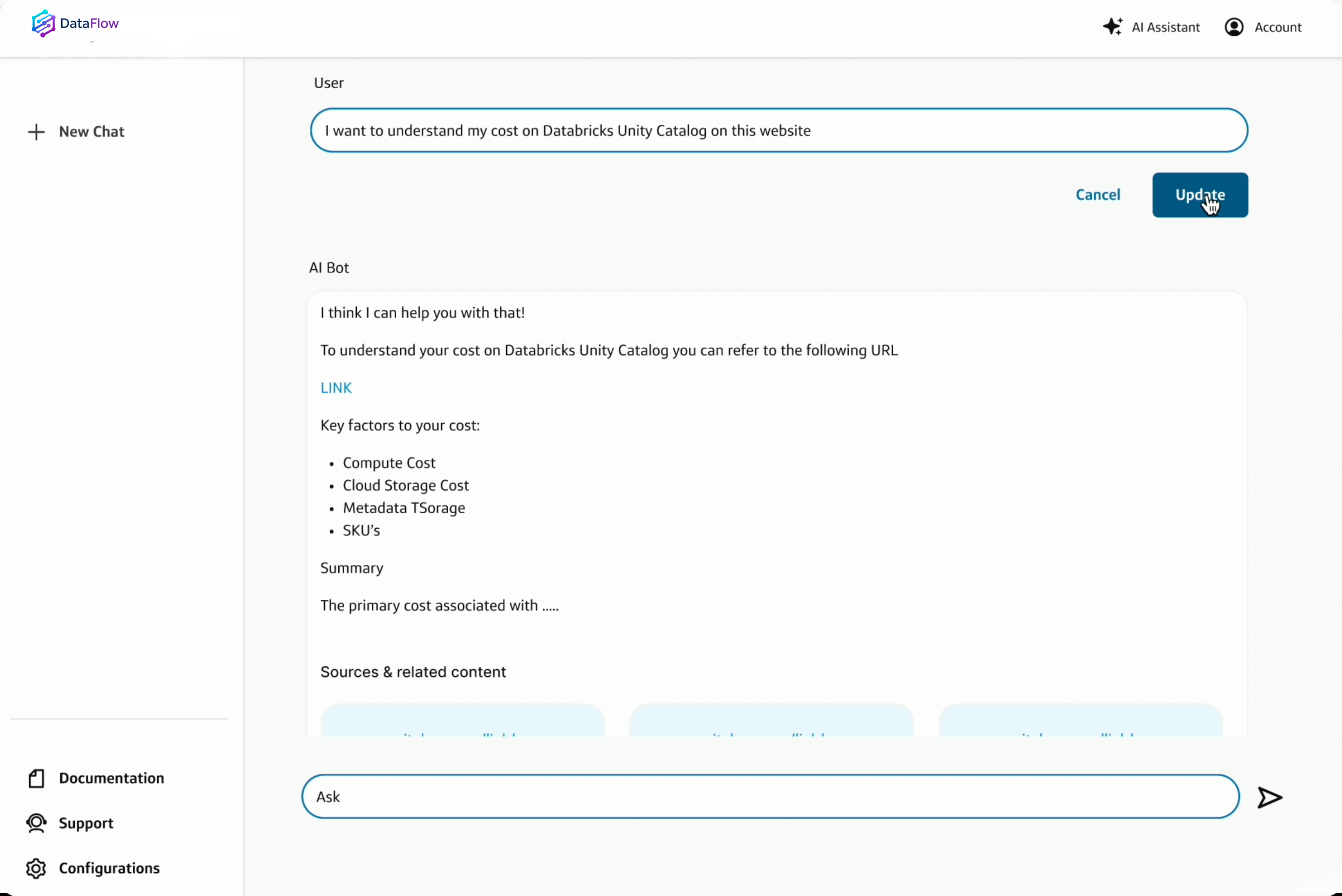
Evolved from a chat-first explainer into a context-aware, agentic decision surface that helps users understand, validate, and operationalize query optimizations as trust and AI maturity increased.
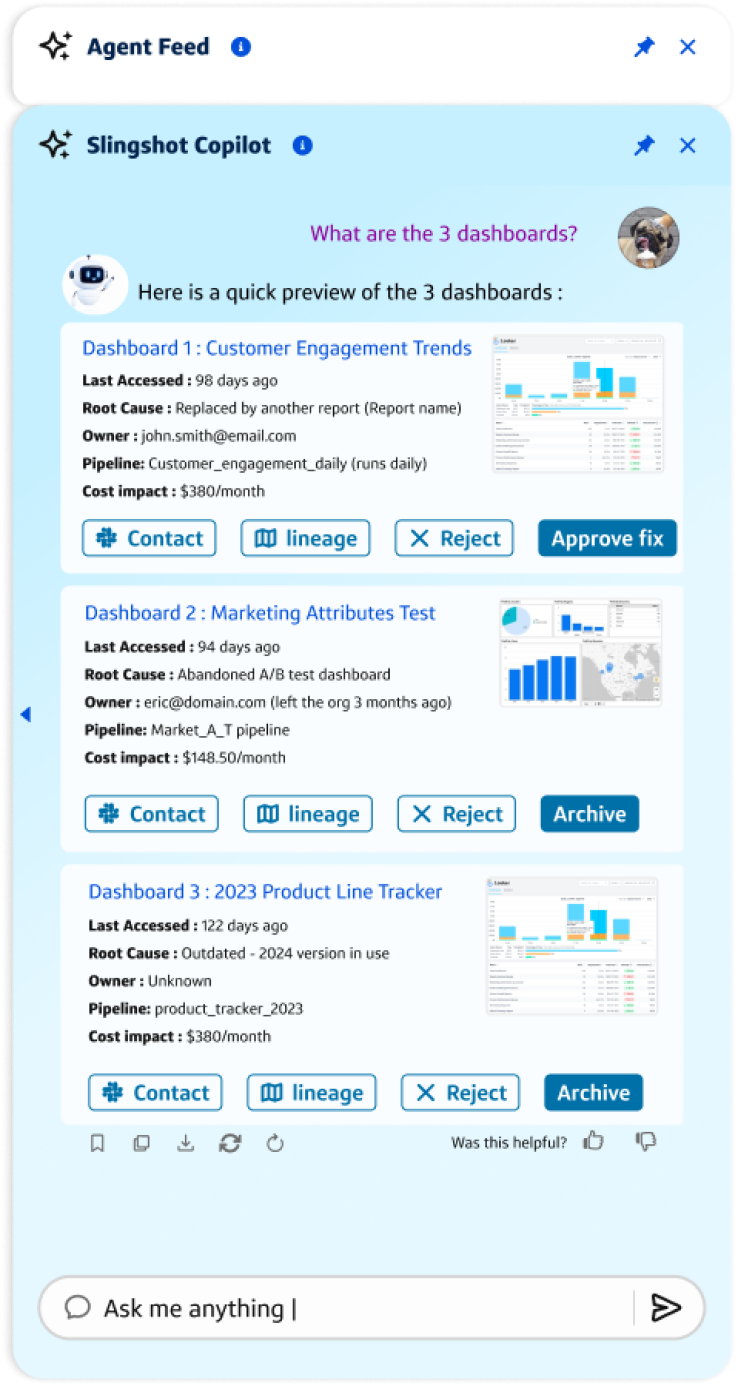
Optimization Agent
The optimization agent proactively analyzes system signals, proposes actions, and requires explicit human approval before executing high-impact changes.
Validation & Impact
Impact - before and after
Validation surfaces compare before-and-after performance, cost, and runtime signals to confirm that changes had the intended effect and did not introduce regressions.
Safety & Guardrails
Guardrails enforce permissions, confidence thresholds, and approval checkpoints to ensure the system acts responsibly within enterprise constraints.
Key Learnings
-
Trust must be designed explicitly (evidence, confidence, approval), not implied
-
Users adopt AI when they can see why a recommendation exists and what happens next.
Agentic systems require UX for:
-
Reasoning visibility
-
Human-in-the-loop control
-
Validation over time
-
Query optimization is a system-level problem, not a SQL syntax problem.
Outcome
- Designed a reasoning-first agent loop: Detect → Diagnose → Recommend → Act → Observe
- Introduced evidence-first UX (lineage, SQL diffs, cost impact).
- Shifted optimization from reactive investigation to proactive, explainable intelligence.
- Designed agentic workflows that require explicit human approval for high-impact actions
- Established an “Observed Impact” loop to validate outcomes and inform future decisions
Demo - Design MVP prototype
MVP
I translated the agentic system vision into MVP-ready design artifacts that engineering could realistically build and test. This included finalized end-to-end flows for Query Optimization and Duplicate Pipelines, with annotated interaction designs that clearly defined system behavior, multi-step reasoning sequences, and explicit human-in-the-loop approval points. The MVP intentionally separated what the system detects, what it recommends, and what requires human approval, with guardrails and constraints designed directly into scope to ensure safety, trust, and feasibility during early implementation.
Tech Stack for MVP
Platforms & Technologies (Design Context)
- Data platforms: Snowflake, Databricks
- Storage & analytics: ClickHouse (telemetry)
- Knowledge graph: Neo4j
- AI / LLMs: Claude, GPT, Gemini (prototyping & evaluation)
- Frontend: React (Slingshot platform)
Key Learnings
Agentic intelligence can be introduced incrementally, even when early implementations rely on partially deterministic logic. Explicit reasoning visibility and evidence surfaces significantly reduced hesitation and risk during early adoption. Engineering alignment accelerated when behavioral intent and decision logic were clearly designed—rather than relying on static UI specifications. Most importantly, MVP success depended more on trust, clarity, and user control than on full autonomy or automation.
Outcome
The agentic system design was adopted as Slingshot’s flagship AI direction for Summit 2026, moved into technical POC and testing, and validated through executive demos, leadership reviews, and early customer feedback—demonstrating how design can lead AI strategy before full models, PRDs, or platforms are in place.
Impact
Overall Impact
-
Transformed Slingshot from reactive dashboards into context-aware, agentic intelligence
Reduced reliance on manual investigation through reasoning-first AI workflows
Consolidated fragmented analysis across cost, performance, and lineage into a single experience
Established durable AI UX foundations for:Trust
Explainability
Human oversight
Demonstrated how design can lead AI strategy — before models, PRDs, or platforms are fully in place
-
Transformed Slingshot from reactive dashboards to context-aware, agentic intelligence.
Reduced manual RCA and optimization effort (target: 25–40%).
Consolidated investigation workflows from multiple tools into a single experience.
Established AI UX foundations for trust, explainability, and human oversight.
Demonstrated how design can lead AI strategy before models, PRDs, or platforms exist.